The 3 Core Pricing Models: One-Time, Subscription, and Usage-Based
Every pricing model is built on three fundamentals: one-time, subscription, and usage-based pricing. Understanding the trade-offs of each — and how to combine them — is the foundation of sustainable revenue design for any B2B or SaaS business.
RevExOS
Q2C Consulting
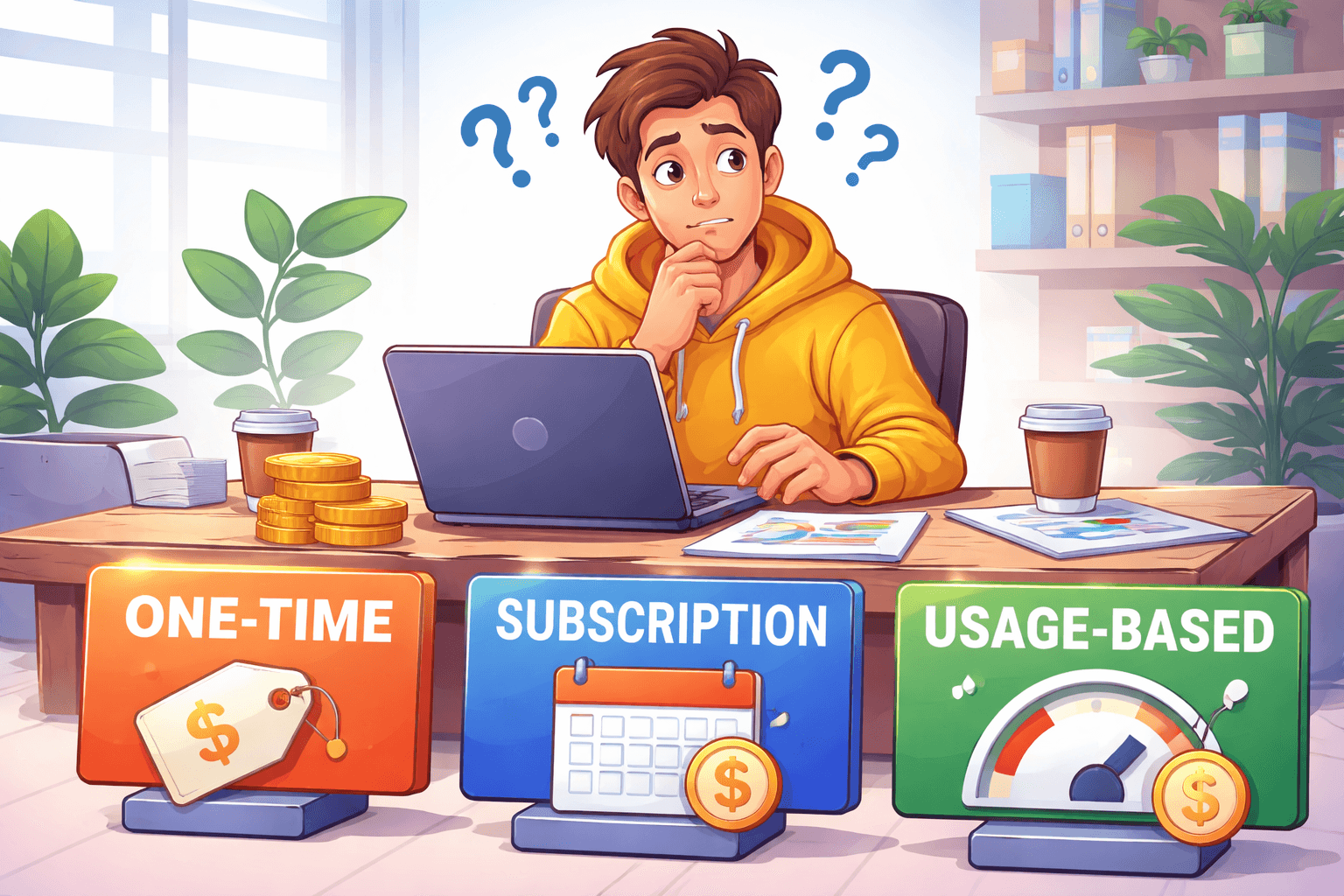
The 3 Core Pricing Models Every Business Should Understand
Pricing is not just about how much you charge. It is about how value flows from customers to your business over time — and how that flow behaves when usage changes, contracts evolve, and customers grow or shrink.
Every pricing model that exists — from a $9.99/month SaaS subscription to a $500,000 enterprise usage commitment — is a combination of three fundamental types. Understanding what each type does, where it breaks down, and how they combine is the foundation of revenue design that does not leak.
The Three Types
1. One-Time Pricing
A customer pays once and receives permanent access or a defined deliverable. No recurring charges, no ongoing billing relationship.
Common examples:
- Desktop software licenses (one-time purchase, no subscription)
- E-books, courses, and digital downloads
- Lifetime deal pricing
- Hardware or physical products
- Fixed-fee consulting projects or implementation engagements
How revenue works: Revenue is fully recognised at the point of delivery. Cash is collected immediately or on defined milestones. There is no recurring revenue stream — each sale is a new revenue event.
What it does well:
- Simple to understand and sell — no complex billing, no renewal conversations
- Immediate cash inflow for the seller
- No billing infrastructure beyond basic invoicing
- Customers who are allergic to subscriptions buy more readily
Where it breaks:
- Revenue is not predictable. You must continuously close new deals to maintain revenue levels.
- There is no natural ongoing relationship — once the product is delivered and paid for, there is no billing touchpoint to maintain the customer relationship
- Funding ongoing support, maintenance, and improvement is difficult because there is no recurring revenue to pay for it
- Lifetime deals are particularly dangerous at scale — you commit to unlimited future delivery for a fixed upfront payment, which inverts your cost structure as usage grows
When one-time pricing makes sense: Low-maintenance products where value is delivered once. Clear, finite deliverables. Customers who strongly prefer ownership over subscription. Education products, templates, tools.
2. Subscription / Recurring Pricing
A customer pays a fixed amount periodically — monthly, quarterly, or annually — to maintain access to a product or service. Access ends when payment stops.
Common examples:
- SaaS products (CRM, email tools, design software)
- Streaming services
- Managed services and retainers
- Membership platforms
- Annual software maintenance agreements
How revenue works: Revenue is recognised ratably over the subscription period. Under ASC 606/IFRS 15, an annual prepayment is not revenue — it is deferred revenue (a liability) that becomes earned revenue as each period passes. This matters for financial reporting, not just cash flow.
What it does well:
- Predictable, recurring cash flow enables planning and investment
- Customer lifetime value (LTV) compounds — a customer who stays two years is worth two years of payments
- The business model creates a structural incentive to keep improving the product, because customers can leave each renewal cycle
- Metrics like MRR and ARR give finance teams and investors a forward-looking view of revenue
Where it breaks:
- Churn is the structural risk — customers re-evaluate the value proposition at every renewal
- Flat-fee subscriptions do not scale with value delivered. A high-usage customer pays the same as a low-usage customer, which creates pressure on margins and leaves revenue on the table
- For professional services, flat retainers systematically undercharge customers whose needs grow, unless scope boundaries and overage mechanisms are built in
- Billing complexity increases with seat counts, add-ons, mid-term upgrades, and custom discount structures
When subscription pricing makes sense: Products or services that deliver ongoing value. Infrastructure tools, platforms, and anything with continuous updates. Businesses building for long-term customer relationships rather than one-time transactions.
3. Usage-Based / Consumption Pricing
A customer pays based on how much they actually use the product. The price scales with consumption rather than access.
Common examples:
- Cloud infrastructure (AWS, GCP, Azure — billed by compute hours, storage, bandwidth)
- APIs and developer tools (Stripe, Twilio, OpenAI — billed per transaction or token)
- Telecommunications (pay per minute, per GB)
- Usage-heavy SaaS (billed per email sent, per active user, per processed record)
How revenue works: Revenue in any period depends on actual consumption in that period. Under ASC 606, usage-based revenue is recognised when the usage occurs — which means finance must estimate end-of-period usage, true up when actuals are finalised, and manage accruals and adjustments. This is the most complex model for revenue recognition.
What it does well:
- Aligns price with value — customers pay for what they actually get
- Low barrier to entry: customers can start small without a large commitment
- Revenue scales naturally with customer success and growth
- Natural upsell motion: customers who grow their usage generate more revenue without any sales effort
Where it breaks:
- Revenue is inherently unpredictable. Month-to-month revenue depends on customer usage patterns, which fluctuate.
- Customers struggle to forecast their own costs, which creates friction in the sales cycle and budget approval process
- Metering complexity is significant — you need accurate, real-time measurement of every billable unit, with clear rules for what counts and what does not
- Finance teams face estimation challenges at period-end when usage data is not finalised
- Revenue recognition under ASC 606 requires variable consideration estimation with specific constraints — for detail, see How Modern SaaS Pricing Breaks Finance
When usage-based pricing makes sense: Infrastructure and compute products where costs scale with usage. API-first products where the value per unit is clear. Enterprise SaaS where large customers would push back on fixed seat pricing. Products where the natural unit of value is a transaction, not access.
Hybrid Pricing: How Most Modern Businesses Actually Bill
The reality is that most growth-stage B2B and SaaS companies use hybrid pricing — combining two or three of these models in a single customer relationship.
Common hybrid structures:
Base fee + usage (most common in B2B SaaS): A fixed monthly platform fee covers a committed level of usage or seats. Usage above that level is billed per unit. This gives customers cost predictability while aligning revenue with high-usage customers.
Example: $500/month platform fee, includes 10,000 API calls. Additional calls billed at $0.05 each.
Implementation fee + subscription: A one-time setup or onboarding fee followed by recurring access. Common in professional services and enterprise software. The one-time fee funds implementation; the subscription funds ongoing value.
Example: $15,000 implementation fee + $2,000/month platform subscription.
Committed use + overage: A customer commits to a minimum monthly spend in exchange for a volume discount. Usage above the commitment is billed at a higher rate. Common in infrastructure and enterprise SaaS.
Example: $3,000/month minimum commitment at $0.03/unit. Units above 100,000 billed at $0.05.
Tiered subscription with feature gating: Different subscription tiers (Starter, Growth, Enterprise) with different feature sets. Revenue jumps at tier boundaries as customers upgrade.
The Revenue Operations Implications
Each pricing model creates different operational requirements:
| Pricing Model | Billing Complexity | RevRec Complexity | Churn Risk | Revenue Predictability |
| One-time | Low | Low | N/A | Low |
| Subscription (flat) | Moderate | Low-moderate | High | High |
| Subscription (seat-based) | Moderate | Moderate | Moderate | High |
| Usage-based | High | High | Low | Low |
| Hybrid | High | High | Moderate | Moderate |
Hybrid models are increasingly standard in enterprise SaaS, but they create the highest operational overhead. Every customer relationship combines elements that need separate billing logic, separate revenue recognition treatment, and separate handling in your finance systems.
This is why companies with complex pricing models often find their month-end close taking 10–15 business days instead of 5–7 — the pricing complexity has outgrown the manual processes that were built to handle simple subscription billing.
Choosing the Right Model
The right pricing model is not the one that looks best on a pricing page. It is the one that:
- Aligns with the unit of value you actually deliver — if customers value access, charge for access; if they value outcomes, charge per outcome; if they value consumption, charge per unit consumed
- Can be billed accurately with your current or planned infrastructure — complex usage models require metering infrastructure; if you cannot measure usage reliably, you cannot bill for it reliably
- Your customers can understand and forecast — especially in enterprise sales, pricing must be explainable and forecastable; usage models that are hard to predict create friction in procurement
- Finance can recognise correctly under your accounting standard — complex hybrid models can create significant ASC 606 compliance challenges; involve finance in pricing design before contracts are signed
- You can operate at scale without manual intervention — a pricing model that requires human involvement in every billing cycle does not scale; automation requirements should be part of the pricing design
There is no universally correct pricing model. There is only the model that correctly encodes how your business delivers value — and the infrastructure to operate it accurately.
For a deeper look at how modern SaaS pricing creates specific revenue recognition challenges, see How Modern SaaS Pricing Has Broken Finance.