SAP BRIM for Tech Companies: Setup Guide (2026)
A practical guide to SAP BRIM for subscription and consumption billing: architecture, key components, real use cases, and where it fits in your Q2C stack.
RevExOS
Q2C Consulting
Most billing systems were built for simple, predictable transactions. Sell a product, issue an invoice, collect payment. That model worked when revenue meant selling licenses or shipping hardware. It does not work when your customers pay per API call, per GB processed, per active user, or some combination of all three on a monthly basis.
This is the problem SAP Billing and Revenue Innovation Management - BRIM - was designed to solve.
BRIM is SAP's enterprise-grade platform for managing complex, high-volume billing across subscription, consumption, and hybrid pricing models. It is not a lightweight SaaS billing tool. It is infrastructure built to handle the full lifecycle of a revenue contract, from the initial order through rating, charging, invoicing, revenue recognition, and cash collection, at the scale that large technology companies require.
This post is a practical guide for tech companies evaluating BRIM, already implementing it, or trying to understand whether it is the right fit for their billing architecture. It covers what BRIM actually does, how it handles subscription and usage pricing, where it creates the most value, and what the realistic implementation picture looks like.
What SAP BRIM Is - and What It Is Not
SAP BRIM is not a single product. It is a suite of integrated modules within the SAP S/4HANA ecosystem, each responsible for a specific phase of the billing lifecycle. Understanding the architecture matters because the value BRIM delivers comes from how the modules connect, not from any individual component in isolation.
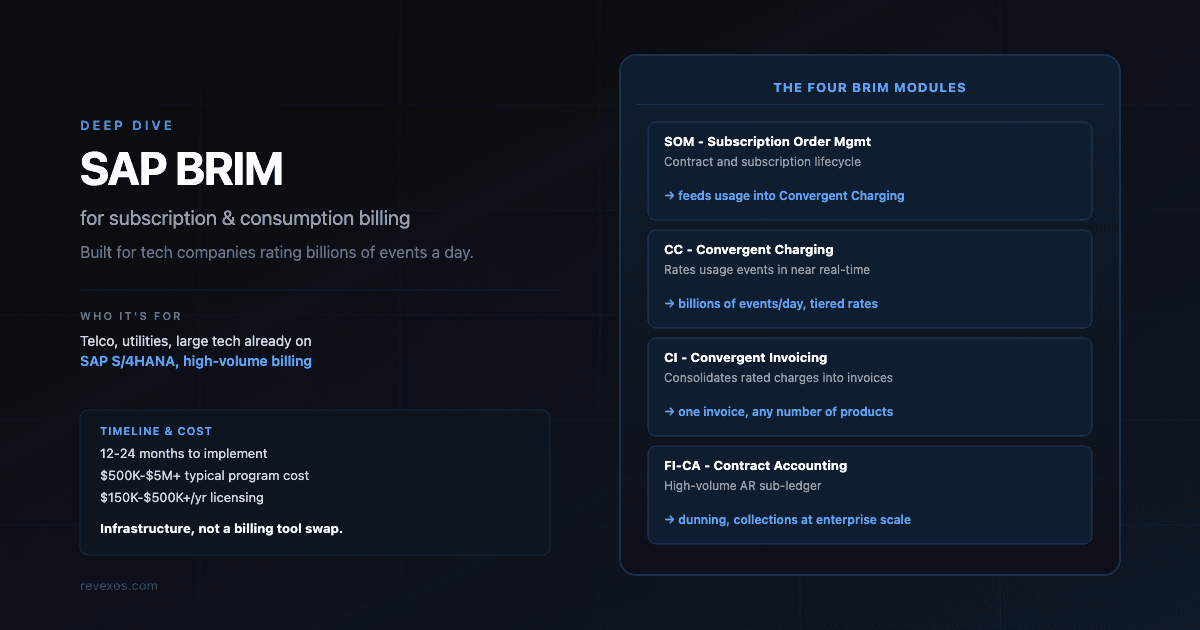
The four core components of SAP BRIM are:
SAP Subscription Order Management (SOM) SOM is where contracts live. It handles the full subscription lifecycle: creation, activation, modification, suspension, and termination. Every product the customer is entitled to, every pricing rule that applies to them, and every event that changes their entitlements is managed here. SOM is the system of record for what the customer has agreed to and what they are owed.
SAP Convergent Charging (CC) CC is the rating engine. It takes raw consumption events - API calls, compute minutes, data records, transactions - and converts them into chargeable items using the pricing rules defined in the product catalog. This is where usage-based pricing gets its muscle. CC can rate billions of events per day, apply tiered rates, apply promotions and discounts, handle retroactive corrections, and produce the financial output that feeds invoicing.
SAP Convergent Invoicing (CI) CI aggregates the chargeable items from CC and the subscription charges from SOM and produces invoices. It handles the merging of multiple charge streams onto a single invoice, manages billing cycles and billing document hierarchies, and handles the output formats that customers receive.
SAP Contract Accounting (FI-CA) FI-CA is the financial backbone. It manages the accounts receivable sub-ledger for contract-based revenue: posting charges, tracking payments, managing disputes and credits, and reconciling with the general ledger. It is purpose-built for high-volume, contract-based business models rather than the transaction-by-transaction model of standard AR.
Together, these four modules cover the full arc from order to invoice to cash. When they are integrated correctly, data flows automatically through each phase without manual handoffs. A customer changes their subscription tier, SOM updates the entitlement, CC applies the new pricing rules to future consumption, CI generates the corrected invoice at the next billing cycle, and FI-CA posts the financial entries to the sub-ledger - all without manual intervention.
How BRIM Handles Subscription Billing
Subscription billing sounds simple: charge the customer a recurring fee at a fixed interval. In practice, enterprise subscription billing is anything but simple.
A typical enterprise technology subscription involves:
- Multiple subscription lines with different start dates, billing frequencies, and renewal terms
- Seat-based pricing where the count changes mid-period
- Add-on modules with their own prices and billing cycles
- Promotional pricing that applies for a defined period and then expires
- Ramp schedules where the price escalates over the contract term
- Volume discounts that apply across the entire account, not just individual lines
- Entitlements that must be activated, tracked, and de-activated when the subscription changes
BRIM's SOM module handles all of this within a structured subscription data model. Each subscription is represented as a set of contract accounts, subscription orders, and products, with pricing conditions applied at the appropriate level of the hierarchy. Changes to any element of the subscription, like a seat count increase or a tier upgrade, trigger automated re-rating and invoice adjustment without requiring manual recalculation.
Proration and Mid-Cycle Changes
One of the most common pain points in subscription billing is proration. When a customer upgrades mid-cycle, adds seats on day 12 of a 30-day billing period, or cancels with 8 days remaining, every billing system must decide how to handle the math. Most lightweight billing tools handle this with simple date-based proration. BRIM handles it with configurable proration logic that can be set at the product, contract, or customer level.
For example, a technology company with enterprise customers might configure:
- Day-based proration for seat additions (charge for the exact number of days remaining)
- Full-period billing for plan upgrades (upgrade takes effect at the next billing cycle)
- Partial-period credit for downgrades (credit the unused portion of the current period)
- No proration for add-on modules below a certain value threshold
These rules are defined once in the product catalog and applied automatically at scale. A finance team that previously spent two days per month reconciling proration credits on 300 enterprise accounts can eliminate that work entirely when BRIM's proration logic is properly configured. To check a single mid-cycle change by hand, the free Proration Calculator shows the credit for unused time, the charge for the new plan and the net amount to invoice.
Ramp Deals and Multi-Year Contracts
Enterprise technology sales frequently involve ramp pricing: Year 1 at a base price, Year 2 at an escalated rate, Year 3 higher still. BRIM models these natively within the contract structure, with pricing conditions that activate based on the contract anniversary date rather than requiring manual price updates.
This matters for revenue recognition as well as billing. When a multi-year contract with ramp pricing is recorded in BRIM, the system can expose the full contract value and the period-specific billing schedule to the ERP's revenue recognition engine, enabling the automated calculation of contract assets and liabilities without manual spreadsheet models.
How BRIM Handles Consumption-Based Billing
This is where BRIM's architecture genuinely differentiates from lighter-weight billing platforms. The Convergent Charging module was designed for a specific problem: rating enormous volumes of raw events against complex pricing rules in near real-time.
The Mediation and Rating Pipeline
Before an API call or a compute minute can be billed, it must be collected, validated, deduplicated, and normalized. This upstream process, called mediation, converts raw product telemetry into structured consumption records that the rating engine can process.
For tech companies, mediation typically means:
- Event collection: API gateway logs, product telemetry streams, CDN access logs, or database transaction records flow into the mediation layer in near real-time or in periodic batch files
- Normalization: Events are standardized to a common format - timestamp, customer identifier, product identifier, quantity, and attributes that determine pricing
- Deduplication: Duplicate events (common in distributed systems) are identified and removed before rating
- Enrichment: Events are matched to the active contract and pricing tier for the customer at the time of consumption
SAP provides a mediation tool - SAP Convergent Mediation by DigitalRoute - that integrates with CC and handles the upstream data pipeline. For tech companies that already have a data pipeline infrastructure (Kafka, Flink, Kinesis), the integration point is typically at the normalized event stage, feeding CC directly rather than using SAP's native mediation tooling.
Rating Complex Pricing Structures
Once events reach CC, the rating engine applies the pricing rules to generate chargeable items. This is where BRIM's flexibility becomes critical for tech companies with non-standard pricing.
Volume tiers: CC can apply tiered rates automatically. A customer consuming 50,000 API calls in a month where the pricing is $0.001 per call for the first 10,000 and $0.0008 per call above that will receive a rated output that reflects both tiers without any manual calculation. The tier breakpoints are defined in the product catalog and applied automatically at scale.
Aggregation windows: CC can aggregate events across different windows: per-hour, per-day, per-billing-period. A product billed daily based on peak concurrent connections, for example, requires daily aggregation of hourly event data. CC handles this natively.
Free allowances and commit drawdowns: Many tech companies offer a baseline entitlement (e.g., the first 1,000 API calls per month are included in the subscription fee) with consumption above that threshold billed at a per-unit rate. CC manages this through a concept of rated result offsets: the included allowance is modeled as a credit that is consumed before chargeable units accumulate. When the allowance is exhausted, the rating engine automatically switches to the billable rate.
Bundle pricing across multiple products: Enterprise customers often purchase multiple products from the same vendor, with pricing that depends on the aggregate spend or usage across the bundle. CC supports cross-product rating through account-level pricing conditions that consider total consumption across multiple rated products before determining the applicable rate for each.
Retroactive Corrections
In distributed systems, usage data arrives late. An event that occurred on March 29 may not be finalized in the system until April 5. In most billing systems, this creates an unpleasant choice: hold the invoice until all data is confirmed (delaying billing and cash collection) or send the invoice with estimated data and issue a correction later (creating operational overhead and customer confusion).
BRIM's rating engine handles retroactive corrections through a rebilling mechanism. When late-arriving or corrected events need to be applied to a closed billing period, CC can re-rate the relevant events and generate a delta adjustment document that represents only the difference between the original charge and the corrected charge. This adjustment flows through CI as a debit or credit memo, maintaining a clean audit trail without requiring a full re-invoice of the period.
For technology companies with metering delays - which is essentially all of them - this capability is operationally significant. It eliminates the manual work of identifying affected invoices, calculating corrections, and issuing adjustments that finance teams otherwise absorb at period-end.
Where BRIM Creates the Most Value for Tech Companies
Not every tech company needs SAP BRIM. It is a significant investment in terms of licensing, implementation, and ongoing operations. The companies that extract the most value from BRIM share a few characteristics.
High Event Volumes
If your billing is based on consumption and you are processing millions or billions of events per month, the rating throughput requirements alone justify purpose-built infrastructure. BRIM's CC module is designed for telco-scale event processing - historically, the largest consumer of convergent charging infrastructure was the telecommunications industry, where carriers rate hundreds of millions of voice minutes and data records every day. Technology companies with large-scale API platforms, cloud infrastructure products, or high-frequency transaction systems face similar throughput requirements.
If your monthly billing events are in the thousands or tens of thousands, a lighter-weight billing platform like Zuora, Chargebee, or Stripe Billing will handle the volume and cost significantly less to implement and operate.
Complex Pricing Models Across Large Account Portfolios
BRIM's value scales with pricing complexity and customer count. A tech company with 50 enterprise customers, each on a custom pricing structure with multiple subscription lines, consumption commitments, and entitlement bundles, is exactly the profile that BRIM serves well.
The pricing catalog in BRIM is hierarchical and condition-based: pricing rules can be defined at the product level, overridden at the customer group level, and further customized at the individual contract level. This allows a single product to be sold at hundreds of different effective prices without requiring separate product catalog entries for each customer. For enterprise sales teams that regularly negotiate custom pricing, this catalog flexibility is operationally essential.
Integration with SAP ERP
If your company is already running SAP S/4HANA or SAP ECC as its ERP, the case for BRIM strengthens considerably. The native integration between BRIM modules and the core financials means that billing events, payments, and contract liabilities post directly to the general ledger without a custom integration layer. Revenue recognition data from BRIM flows into SAP's revenue accounting module (RAR) automatically, enabling automated ASC 606 / IFRS 15 compliance at scale.
For companies not on SAP ERP, BRIM can still be implemented, but the integration effort increases substantially. Custom APIs must be built between BRIM and the ERP, and the tight data coupling that drives BRIM's automation advantage is harder to achieve.
Multi-Country and Multi-Currency Billing
Technology companies operating globally face significant complexity in billing: different tax regimes, different invoice formats, different currency requirements, different payment terms. BRIM handles multi-country billing natively, with tax determination, currency conversion, and invoice localization built into the platform. A single billing run can produce invoices in 40 countries with the correct local tax treatment, currency, and format for each.
For tech companies scaling internationally, this globalization capability often justifies BRIM even before considering the subscription and usage billing features.
Real-World Use Cases in Technology
Cloud Infrastructure Provider
A cloud infrastructure provider charges customers based on compute hours, storage GB, and data transfer. Pricing is tiered: lower per-unit costs at higher volume. Enterprise customers have committed spend contracts with overage at published rates.
BRIM architecture for this scenario:
- SOM manages the committed spend contracts, renewal terms, and entitlement bundles
- CC rates raw compute, storage, and transfer events against the applicable tier structure for each customer
- CI generates a single monthly invoice that consolidates all service lines, shows commitment drawdown and overage separately, and applies enterprise pricing
- FI-CA manages the accounts receivable, cash posting, and dispute handling
- Revenue recognition data flows to SAP RAR, where committed prepayment is held as deferred revenue and recognized as the customer draws down their commitment
Enterprise SaaS Platform
An enterprise SaaS company sells a platform with a base subscription (per-seat, annual), add-on modules (flat fee, separate billing cycle), and a usage component (transactions processed, billed monthly in arrears).
BRIM architecture:
- SOM manages all three components as separate subscription products within a unified account hierarchy
- The seat subscription generates recurring charges automatically at the annual billing date, prorated for mid-year seat changes
- Module add-ons bill at their own cycle, with activations and cancellations handled through SOM's subscription change management
- Transaction usage flows through CC daily, rated against the transaction pricing tier, and accumulated in CI for monthly invoicing
- All three components converge on a single customer invoice that finance, the customer, and accounts payable can reconcile against
Telecommunications-Adjacent Tech Company
A messaging platform or communications API provider sells access to SMS, voice, and video services on a pure consumption basis with no subscription floor. Customers are billed monthly based on actual usage with pricing that varies by destination country, message type, and volume.
BRIM was originally built for exactly this model. CC's origin in telco billing means the pricing catalog supports destination-based rating natively: a rate table maps message type + destination country to a per-unit price, and CC applies the correct rate to each event automatically. At volumes of hundreds of millions of messages per month, this is the class of system that can handle the load.
The Implementation Reality
BRIM implementations are significant projects. A mid-sized technology company should budget 12-24 months for a full BRIM implementation, with an experienced SAP partner, and a project team that includes representatives from finance, billing operations, IT, and product. The variables that drive the timeline are the complexity of the pricing catalog, the number of integration points with existing systems (CRM, product telemetry, ERP, tax platform), and the volume of historical data that must be migrated.
Common implementation challenges:
Data migration: Existing customer contracts, historical billing data, and open balances must be migrated into BRIM before the system can go live. For companies with years of billing history in legacy systems, this is often the longest-lead item on the implementation timeline.
Product catalog design: The hierarchical pricing catalog is powerful, but it requires careful upfront design. Catalog structures that work for the current pricing model but cannot accommodate future pricing changes create expensive rework. Investing time in catalog architecture before implementation begins pays significant dividends.
Integration with the consumption data pipeline: Getting usage events from the product into CC in the right format and at the right frequency requires close collaboration between the engineering team (who owns the telemetry infrastructure) and the BRIM implementation team. This integration is typically custom to each company's product architecture.
Testing at scale: BRIM must be tested with realistic event volumes before go-live. Performance testing at production-level loads is not optional for high-volume billing environments.
The companies that implement BRIM successfully invest in a dedicated billing operations function that owns the system configuration, product catalog maintenance, and incident response after go-live. BRIM is not a configure-and-forget tool; it is an operational platform that requires ongoing stewardship.
Where BRIM Fits in the Modern Q2C Stack
SAP BRIM covers billing, rating, invoicing, and accounts receivable. It does not cover sales-side quoting (that is the domain of CPQ tools like SAP CPQ or Salesforce CPQ), CRM (Salesforce, HubSpot, or SAP CRM), or revenue recognition beyond what RAR provides (for complex multi-element arrangements, dedicated RevRec tools may supplement BRIM's output).
The modern Q2C stack for a tech company running BRIM typically looks like:
| Phase | System |
|---|---|
| Opportunity management | Salesforce or SAP CRM |
| Configure, price, quote | SAP CPQ or Salesforce CPQ |
| Contract management | SAP CLM or DocuSign CLM |
| Subscription order management | SAP SOM (BRIM) |
| Usage metering and rating | SAP CC (BRIM) |
| Invoicing | SAP CI (BRIM) |
| Accounts receivable | SAP FI-CA (BRIM) |
| Revenue recognition | SAP RAR or third-party RevRec |
| General ledger | SAP S/4HANA |
The key integration points are at the left and right edges of the BRIM layer: the handoff from CPQ to SOM when a contract is signed, and the handoff from FI-CA and RAR to the general ledger for period-end reporting.
Should Your Tech Company Use SAP BRIM?
BRIM is the right choice if you are a technology company with:
- High-volume consumption billing (millions of events per month)
- Complex, multi-component pricing that includes both subscription and usage elements
- A large enterprise customer portfolio with custom pricing and entitlement structures
- Existing or planned investment in SAP ERP
- Multi-country operations that require localized billing and tax compliance
- A dedicated billing operations team or the capacity to build one
BRIM is probably not the right choice if you are:
- A growth-stage SaaS company with fewer than 200 customers and straightforward pricing
- Running on a non-SAP ERP with no plans to migrate
- Looking for a fast implementation - Zuora, Chargebee, or Stripe Billing will get you live in weeks, not months
- Operating in a single country with a single currency and simple tax structure
The honest assessment is that BRIM's power comes with corresponding complexity. The companies that invest in it correctly get a billing infrastructure that can scale with them for a decade, handle pricing models they haven't invented yet, and integrate seamlessly with their financial systems. The companies that underinvest in implementation or operations get an expensive system that never fully delivers on its promise.
What RevExOS Does in BRIM Environments
For tech companies running SAP BRIM, the system handles billing mechanics well. What it does not handle is the business process layer that sits above the technology: making sure that pricing design decisions are RevRec-friendly before contracts are signed, that the Q2C handoffs between Salesforce CPQ and SOM are clean and complete, that usage data pipeline gaps do not create billing errors, and that the finance team has a real-time view of billing health rather than discovering issues at month-end close.
RevExOS works in BRIM environments to:
- Audit the Q2C process from quote through cash to identify where data is being lost or manually re-entered at system handoffs
- Design and document the product catalog structure so that pricing complexity is modeled correctly in BRIM from the outset
- Build the integration layer between product telemetry and Convergent Charging for companies standing up consumption billing for the first time
- Align finance and billing operations on the revenue recognition treatment of new pricing structures before they go into production
- Accelerate the close by building reconciliation frameworks that catch billing errors in-period rather than at month-end
If you are implementing BRIM, evaluating it, or running it and the expected automation has not fully materialized, compare it against other options with the Billing Platform Selector, or ask me about a specific gap.
Frequently Asked Questions
What does SAP BRIM stand for?
SAP BRIM stands for Billing and Revenue Innovation Management. It is SAP's integrated platform for subscription billing, consumption-based billing, invoicing, and contract accounts receivable, designed for businesses with high-volume, complex billing requirements.
What are the main components of SAP BRIM?
The four core components are: SAP Subscription Order Management (SOM) for contract and subscription lifecycle management; SAP Convergent Charging (CC) for usage event rating; SAP Convergent Invoicing (CI) for invoice generation; and SAP Contract Accounting (FI-CA) for accounts receivable management.
How does SAP BRIM handle usage-based billing?
Usage events from the product are collected and normalized through a mediation layer, then rated by SAP Convergent Charging against the pricing rules in the product catalog. CC supports tiered rates, volume discounts, free allowances, and retroactive corrections. Rated output accumulates in CI for invoice generation at the billing cycle.
Is SAP BRIM only for large enterprises?
BRIM is designed for high-volume, high-complexity billing environments. Most implementations are at large enterprise technology companies, telecommunications providers, utilities, and media companies. Growth-stage companies with simpler billing needs will find lighter-weight tools more cost-effective.
How long does a SAP BRIM implementation take?
A typical BRIM implementation at a mid-sized technology company takes 12-24 months, depending on pricing complexity, number of system integrations, and data migration scope. Implementations that are scoped narrowly - for example, standing up consumption billing for a single product before expanding - can complete in 6-9 months.
Can SAP BRIM integrate with Salesforce?
Yes. BRIM integrates with Salesforce CRM and Salesforce CPQ through standard SAP integration tools (SAP Integration Suite) or custom APIs. The typical integration connects CPQ contract output to SOM for subscription order creation, and FI-CA payment status back to Salesforce for account management visibility.
Not sure if BRIM is the right call for your stack? Take the 2-minute Billing Platform Selector - answer six questions about your revenue, existing systems, and billing complexity and get a specific recommendation between SAP BRIM, Zuora, Salesforce Revenue Cloud, Stripe Billing, or nothing enterprise-grade yet.
RevExOS is a free learning hub for quote-to-cash automation: guides, tools and real projects. See the lead-to-cash map for more on each step.
 Stripe
 Salesforce
 Zuora
Zuora SAP
SAP