SAP BRIM vs Zuora: 2026 Billing Platform Comparison
SAP BRIM runs inside S/4HANA for high-volume consumption billing; Zuora is a standalone subscription platform. Compare architecture, cost, and fit before you choose.
RevExOS
Q2C Consulting
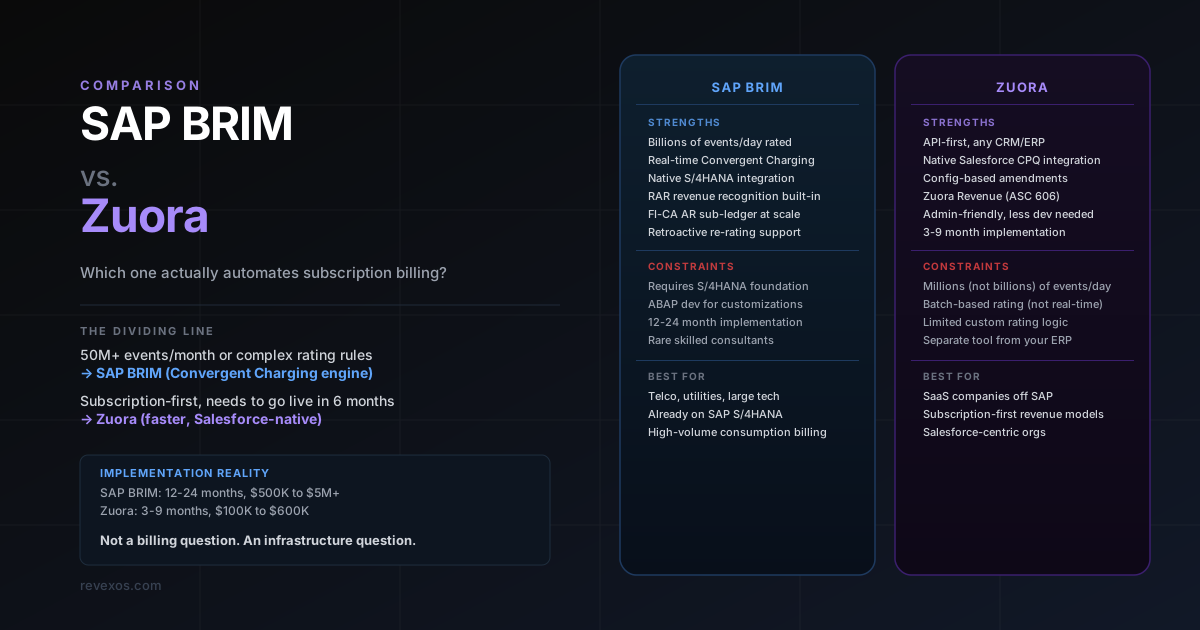
The choice between SAP BRIM and Zuora comes up in two very different contexts.
The first is a large enterprise already running SAP S/4HANA evaluating whether to extend into BRIM for billing, or bring in Zuora as a best-of-breed layer. The second is a mid-market SaaS company that has outgrown Stripe Billing and is trying to decide between the two most commonly evaluated enterprise platforms.
In both cases, the comparison gets muddied because the two products were built with fundamentally different assumptions about what billing automation means. This post is a direct, practical comparison - architecture, capabilities, implementation reality, and a clear view of who should choose which.
What Each Platform Was Actually Built For
SAP BRIM (Billing and Revenue Innovation Management) is not a standalone product. It is a set of modules within SAP S/4HANA: Subscription Order Management (SOM), Convergent Charging (CC), Convergent Invoicing (CI), and Contract Accounting (FI-CA). These modules were built to handle high-volume, high-complexity billing for industries like telecommunications, utilities, and large technology companies running hybrid pricing models at scale. Think hundreds of millions of usage events per day routed through a real-time rating engine.
Zuora is a standalone subscription management and billing platform built specifically for software and services companies transitioning to recurring revenue models. It was designed to connect to any CRM, any ERP, and any payment processor via API. Zuora introduced much of the vocabulary the industry now uses for subscription billing: the subscription object, the rate plan charge, the amendment, the renewal workflow.
The simplest way to state the difference: BRIM is infrastructure for billing at scale inside SAP. Zuora is a product for subscription management that connects to your existing stack.
Architecture Comparison
SAP BRIM
BRIM operates as a set of integrated SAP modules. Data flows through a defined sequence: SOM manages the subscription contract and entitlements, CC rates raw usage events against the pricing catalog, CI aggregates charges and produces invoices, and FI-CA manages the AR sub-ledger.
This architecture has a key strength: when the modules are properly integrated, the billing cycle runs end-to-end without manual handoffs. A customer changes their subscription tier in SOM; CC picks up the new pricing rules; CI produces the corrected invoice at the next billing cycle; FI-CA posts the financial entries. The entire chain is inside one system.
The constraint: this architecture requires SAP S/4HANA as the foundation. You cannot deploy BRIM without it. And because BRIM is SAP, customizations go through SAP's development environment (ABAP or BTP), not via configuration screens.
Zuora
Zuora's architecture is product-centric. The core object is the Subscription, which contains rate plan charges (recurring fees, one-time charges, usage charges). Subscriptions connect to Accounts (customers), Products (catalog), and Invoices.
Zuora sits as an API layer between your CRM (usually Salesforce) and your general ledger (usually NetSuite, SAP, or Workday). Orders flow in from the CRM via Zuora's Salesforce CPQ integration or its API. Invoices and revenue data flow out to the ERP via Zuora's native connectors.
This architecture has a different strength: flexibility and connectivity. You can run Zuora without SAP. You can connect it to Salesforce on one side and NetSuite on the other. Adding a new pricing model is a configuration change, not a development project.
The constraint: Zuora's processing scale for raw usage events is not in the same category as BRIM's Convergent Charging engine. Companies rating billions of usage events per day in real time should look at BRIM, not Zuora.
Subscription Billing: Head to Head
| Capability | SAP BRIM | Zuora |
|---|---|---|
| Recurring charges | Yes, via SOM | Yes, core product |
| Billing cycles | Monthly, quarterly, annual, custom | Monthly, quarterly, annual, custom |
| Mid-cycle changes (upgrades, downgrades) | Yes, with proration rules | Yes, with amendment workflow |
| Seat-based pricing | Yes | Yes |
| Multi-element bundles | Yes | Yes |
| Multi-currency billing | Yes, SAP multi-currency engine | Yes, per-subscription currency |
| Multi-entity billing | Yes, via SAP company code structure | Yes, via Zuora Multi-entity |
| Credit notes and adjustments | Yes, FI-CA handles credit posting | Yes, native credit balance management |
| Renewal automation | Yes, SOM manages renewal workflow | Yes, native renewal workflow |
| Quote-to-subscription handoff | Requires CRM integration or custom build | Native Zuora CPQ or Salesforce CPQ integration |
For pure subscription billing, both platforms are mature and capable. The differentiation shows up in the integration cost (BRIM requires SAP infrastructure; Zuora does not) and in the amendment workflow flexibility (Zuora's UI-driven amendment process is faster to configure than BRIM's SOM customization).
Usage and Consumption Billing: Head to Head
This is where the platforms diverge most significantly.
| Capability | SAP BRIM (Convergent Charging) | Zuora (Zuora Rating) |
|---|---|---|
| Raw event ingestion volume | Billions of events/day | Millions of events/day |
| Real-time rating | Yes (CC rates in near real-time) | Batch-based rating (nightly or on-demand) |
| Rating rule complexity | Tiered, stepped, volume, cross-product, promotional | Tiered, volume, overage |
| Retroactive re-rating | Yes, CC supports retroactive corrections | Limited, requires workarounds |
| Usage data aggregation | Native within CC | Import via API or file upload |
| Custom rating logic | ABAP or BTP development | Configuration-based, limited custom logic |
For companies with simple usage pricing (per seat, per GB, per API call with basic tiers), Zuora's rating engine is sufficient and significantly easier to configure. For companies with complex, real-time usage pricing - telecom-style event processing, multi-dimensional rating, cross-product bundle discounts applied at the event level - BRIM's Convergent Charging engine is in a different category.
The practical dividing line: if your usage volume exceeds about 50 million events per month, or if your rating rules require logic that Zuora's configuration UI cannot express, BRIM is the more defensible choice.
Revenue Recognition
Both platforms have moved into automated revenue recognition, but they take different approaches.
SAP BRIM revenue recognition runs through SAP Revenue Accounting and Reporting (RAR), which is SAP's ASC 606 / IFRS 15 engine. RAR sits inside S/4HANA and operates on performance obligation logic: it identifies the distinct services promised in a contract, allocates the transaction price across them, and recognizes revenue as each obligation is satisfied. For BRIM customers, revenue recognition is handled natively within the SAP ecosystem, with reconciliation against FI-CA as the AR sub-ledger.
Zuora handles revenue recognition through Zuora Revenue (formerly RevPro), a standalone revenue recognition engine they acquired. Zuora Revenue connects to the billing data in Zuora's core platform and applies ASC 606 allocation rules. It integrates with downstream ERPs (NetSuite, SAP, Workday) to post the recognized revenue entries to the general ledger.
The key difference in practice: For companies already on SAP S/4HANA, BRIM with RAR is a native, integrated path to ASC 606 compliance. For companies not on SAP, Zuora Revenue is a credible revenue recognition engine that avoids requiring a full SAP implementation.
Integration Complexity
SAP BRIM integrations:
- CRM to BRIM: No native Salesforce or HubSpot connector. Requires middleware (Dell Boomi, MuleSoft, custom) or the SAP Sales and Service Cloud if you are all-in on SAP.
- BRIM to GL: Native, because FI-CA posts directly to S/4HANA's general ledger.
- Payment processing: Integrates with SAP's payment infrastructure or connects via custom integration to payment gateways.
- Data migration: Moving historical subscription and billing data into BRIM is one of the hardest parts of the implementation.
Zuora integrations:
- CRM to Zuora: Native Salesforce CPQ integration (well-documented, widely deployed). HubSpot integration exists but is less mature.
- Zuora to GL: Native connectors for NetSuite, SAP S/4HANA, Sage Intacct, and Workday. These connectors are maintained by Zuora and generally reliable.
- Payment processing: Zuora Payments or connects to Stripe, Adyen, Braintree, and others.
- Data migration: Zuora has a data migration framework and most implementation partners have run this process multiple times.
Implementation Reality
SAP BRIM
| Factor | Typical Range |
|---|---|
| Timeline | 12 to 24 months for a full implementation |
| Cost | $500K to $5M+ depending on complexity and SI partner |
| Team required | SAP Basis, ABAP developers, BRIM functional consultants |
| Ongoing maintenance | High - requires SAP-skilled administrators |
| Who implements | SAP implementation partners (Deloitte, Accenture, IBM, Capgemini) |
BRIM implementations are complex by nature. The architecture spans multiple SAP modules that must be configured, integrated, and tested together. The rating engine (CC) requires detailed configuration of every pricing rule in the product catalog. The AR sub-ledger (FI-CA) must reconcile with the general ledger. Most implementations go through at least one scope change during the project.
Zuora
| Factor | Typical Range |
|---|---|
| Timeline | 3 to 9 months for initial go-live |
| Cost | $100K to $600K depending on integration complexity |
| Team required | Zuora admin, Salesforce admin (if using SFDC), ERP integration developer |
| Ongoing maintenance | Moderate - Zuora admins are more available than BRIM specialists |
| Who implements | Zuora professional services, or boutique Zuora implementation partners |
Zuora implementations are faster and more predictable, primarily because the platform is designed for configuration rather than development. The integration with Salesforce CPQ or a CRM is the most variable piece - the complexity there depends on how your current quote-to-order process works.
Pricing
Neither platform publishes list pricing publicly, which means both require a sales conversation. General ranges based on publicly available information and market intelligence:
SAP BRIM: Typically licensed as part of SAP S/4HANA Cloud. BRIM-specific licensing costs range from $150K to $500K+/year in software fees alone, before implementation, infrastructure, and managed services.
Zuora: Pricing is based on the volume of billing transactions processed. Entry-level contracts typically start around $25K-$50K/year for lower-volume deployments. Mid-market deployments commonly run $75K-$200K/year. Large enterprise contracts can exceed $500K/year at very high transaction volumes.
Who Should Choose Which
Choose SAP BRIM if:
- You are already running SAP S/4HANA and want to avoid a multi-system integration layer
- Your usage billing volume is very high (hundreds of millions of events per month or more)
- Your pricing logic is complex enough to require custom rating rules that Zuora's configuration UI cannot express
- Revenue recognition must run within the SAP ecosystem for compliance or internal reasons
- You have the implementation budget and timeline that BRIM requires
Choose Zuora if:
- You are not on SAP S/4HANA and do not want to build a full SAP foundation for billing
- Your subscription billing is the primary revenue model, with usage billing as a secondary component
- You need to be live within 6 months rather than 18
- You want a platform your finance team can administer without deep SAP technical skills
- Your integration layer connects to Salesforce (Zuora's SFDC integration is significantly more mature than BRIM's)
Neither platform is right for you if:
- You are under $5M ARR. At that scale, Stripe Billing or Chargebee handles the complexity without the overhead.
- You are still validating your pricing model. Implement simple billing first, validate the model, then migrate to an enterprise platform.
- You are evaluating based on a demo rather than a production reference customer in your industry. Ask both vendors for a reference from a company with your billing model and your transaction volume.
Not sure which bucket you fall into? Take the 2-minute Billing Platform Selector - answer six questions about your revenue, stack, and billing complexity and get a specific recommendation between SAP BRIM, Zuora, Salesforce Revenue Cloud, Stripe Billing, or nothing enterprise-grade yet.
The Question That Resolves Most Evaluations
After all the feature comparisons, the question that most often resolves BRIM vs. Zuora evaluations is: "Are we already on SAP, and do we want to stay on SAP?"
If the answer is yes to both, BRIM is the natural path. The integration overhead of adding a non-SAP billing platform to an otherwise SAP environment is real, and the SAP ecosystem benefits (native GL posting, RAR revenue recognition, FI-CA sub-ledger) are significant.
If the answer is no to either, Zuora is almost always the faster path to a working subscription billing system - and a faster path to value is worth a great deal when the alternative is a 24-month implementation.
Frequently Asked Questions
- Should I choose SAP BRIM or Zuora for subscription billing?
- Choose BRIM if you're already on SAP S/4HANA, your usage volume exceeds roughly 50 million events per month, or your rating rules need custom logic Zuora's configuration UI can't express. Choose Zuora if you're not on SAP, need to be live within 6 months rather than 18, or your integration layer connects primarily to Salesforce.
- What is the main difference between SAP BRIM and Zuora?
- BRIM is infrastructure for billing at scale inside SAP S/4HANA - a set of integrated modules (SOM, Convergent Charging, Convergent Invoicing, FI-CA) that requires SAP as its foundation. Zuora is a standalone, API-connected subscription management platform that works with any CRM, ERP, or payment processor.
- Does SAP BRIM require SAP S/4HANA?
- Yes. BRIM cannot be deployed without S/4HANA as the foundation, and customizations go through SAP's development environment (ABAP or BTP) rather than configuration screens - unlike Zuora, which runs independently of any ERP.
- At what usage volume does SAP BRIM make sense over Zuora?
- The practical dividing line is around 50 million usage events per month, or when rating rules require logic Zuora's configuration UI cannot express. Zuora's rating engine handles millions of events per day via batch-based rating; BRIM's Convergent Charging engine handles billions of events per day in near real-time.
- How much does a SAP BRIM vs. Zuora implementation cost?
- BRIM implementations typically run $500K to $5M+ over 12-24 months, plus $150K-$500K+/year in software licensing. Zuora implementations typically run $100K-$600K over 3-9 months, with subscription pricing from $25K-$50K/year at entry level up to $500K+/year at large enterprise volumes.
 Stripe
 NetSuite
 Salesforce
 Zuora
Zuora SAP
SAP