Accounts Receivable Explained: What It Is, How It Works, and Why Most Companies Do It Wrong
AR is the money your customers owe you. Simple concept, but the process of actually collecting it is where most businesses quietly hemorrhage cash and time. A complete guide to how AR works, why it breaks, and how to fix it.
RevExOS
Q2C Consulting
You delivered the work. You sent the invoice. Now you wait.
That wait - and everything that can go wrong during it - is Accounts Receivable.
What Is Accounts Receivable?
Accounts Receivable (AR) is the total amount of money owed to your business by customers who have received goods or services but have not paid yet.
On your balance sheet, AR sits as a current asset. It is real money - it is just not in your account yet. Every time you issue an invoice with payment terms (Net 15, Net 30, Net 60), you are creating an AR entry. The clock starts ticking from the moment that invoice is sent.
The distinction between AR and revenue is important: recognising revenue (recording it in your income statement) and collecting the cash are two separate events. You can have high revenue on paper and a cash crisis at the same time if your AR process is broken. This disconnect - between earned revenue and collected cash - is where most business cash flow problems originate.
How the AR Process Actually Works
In theory, AR is a straight line:
Invoice → Customer pays → Done.
In practice, it looks more like this:
- Invoice is issued - usually after delivery of a product or completion of a service
- Invoice lands in the customer's AP queue - where it competes with dozens of others, often awaiting approval from someone who was not involved in the original purchase
- Payment terms tick down - Net 30 means the customer has 30 days to pay; your collection clock has started, theirs has not necessarily started running (the free Invoice Due Date Calculator shows when cash should actually land for a given set of terms)
- Payment arrives (or doesn't) - via bank transfer, cheque, card, or ACH, sometimes with reference information, sometimes without
- Cash application - your team matches the payment to the correct invoice and closes it
- Reconciliation - the books are updated, the invoice is closed, the AR balance decreases
That is the happy path. Most invoices do not follow the happy path.
Where AR Breaks Down
Manual Cash Application
When a payment comes in, someone has to figure out which invoice it belongs to. This sounds simple. It is not.
Customers pay late, combine multiple invoices into one payment, short-pay without explanation, or reference an invoice number that does not match your system. A bank wire arrives with the company name in a slightly different format than your customer record. An ACH credit has a reference number that your AR team cannot map to anything.
The result: your AR team spends 40–60% of their time on matching and reconciliation work that adds zero value to the business and could be automated. The invoices stay open while the matching is pending, making your DSO look worse and your cash flow picture less accurate.
No Systematic Dunning Process
Most businesses send one invoice and hope for the best. When it is not paid on time, maybe someone sends a follow-up email when they notice it in the aging report - usually two to three weeks after the due date.
There is no system. No sequenced follow-up. No escalation path. No personalisation by account value or relationship type. Just reactive emails from whoever notices the problem first.
The data on this is consistent: 84% of finance teams spend 3–10 hours per month manually chasing overdue invoices. That is time not spent on anything strategic. And the results are worse than systematic dunning - customers who would pay faster with a structured nudge do not get one, and genuinely delinquent accounts age without escalation.
Disputes That Kill Cash Flow
A customer disputes an invoice. Now what?
Someone has to pull the original contract, the delivery confirmation, the email thread, the purchase order, and any relevant approval records - often from four different systems that do not talk to each other.
Average dispute resolution time: 2–3 weeks. During that entire window, payment is typically withheld in full, even on the portions of the invoice that are not in dispute. A $50,000 invoice with a $5,000 disputed line item will often not be paid at all until the dispute is resolved.
Multiply this by five disputes per month and you have potentially $250,000 of otherwise collectible AR held up for three weeks at a time.
Part of those three weeks is just working out what kind of dispute it is before anyone knows which documents to pull. A billing-error dispute and a service-issue dispute go to different teams. You can try classifying a real dispute reply in the free Jev API Playground to see how that first routing decision can be made on the first read.
One-Size-Fits-All Collections
Your $500 overdue invoice is getting the same attention, or the same automated email, as your $50,000 one. Or worse, your highest-value accounts are being chased with the same generic reminder template as everyone else, which damages the relationship.
The optimal collections approach varies by account value, relationship length, payment history, and risk profile. A new customer in their first billing cycle needs different handling than a ten-year customer who has historically paid on day 45. An account that has missed three consecutive invoices needs different handling than one that is three days past due.
If you are still writing these by hand, the free AR Collections Email Generator drafts a stage-appropriate email and lets you soften the tone for long-term or high-value accounts.
Without intelligent prioritisation, your team spends equal time on every account regardless of risk or value, and your collections outcomes reflect that.
Key AR Metrics You Should Track
If you are not measuring these, you are operating without visibility:
Days Sales Outstanding (DSO)
The average number of days between issuing an invoice and receiving payment.
Formula: (Accounts Receivable ÷ Total Credit Sales) × Number of Days
A DSO of 30 means you are collecting within your payment terms. A DSO of 60 means customers are using your money for twice as long as they are supposed to. For most B2B businesses, the benchmark is 30–45 days; anything above 60 is a meaningful cash flow problem.
Why DSO Creeps Up, and What Each Fix Is Worth
A high DSO is almost never a customer problem. It is a process problem, and each cause has a fix with a roughly predictable payoff:
| Cause | Fix | Typical DSO reduction |
|---|---|---|
| Invoices batched at month-end (a job done on the 3rd is billed on the 31st) | Trigger the invoice from the delivery event: deal closed, milestone hit, product shipped | 3-7 days |
| No dunning, only reactive follow-up when someone notices | A scheduled sequence that runs on invoice status | 10-20 days (if you have none today) |
| Payments sit unmatched for days | Automated cash application against the bank feed | 2-5 days, plus an accurate aging report |
| Disputes freeze the whole balance for 2-3 weeks | All context (contract, PO, delivery proof, emails) in one view the moment a dispute is flagged | Varies with dispute volume |
| Every overdue invoice gets the same treatment | Prioritise by amount, age and customer risk score | Spread across every segment |
A workable dunning schedule: a reminder 3 days before the due date, a due-date notice, a first overdue notice at day +7, a firm notice at day +14, and escalation to a person at day +30. High-value accounts get a call at day +7 instead of an email; long-standing customers get softer wording; new customers get their terms restated plainly.
What it looks like in practice. One business started with month-end invoicing (an average 15-day delay), no dunning, and a 2-3 day manual cash-application lag, at a DSO of 58 days. After triggering invoices on delivery, running a 5-step dunning sequence and matching payments within 4 hours, DSO was 31 days. On $1M of monthly revenue, those 27 days are about $900,000 released from AR with no new sales.
The mistake to avoid is adding a point solution (a dunning app, an AR portal, a reminder tool) that is not connected to your accounting system. When the two disagree, your team manages both, and DSO can improve on paper while the ledger underneath stays wrong. Real DSO reduction needs billing, CRM, accounting, bank feed and communications in sync.
Collection Effectiveness Index (CEI)
Measures what percentage of collectible AR was actually collected in a period.
Formula: (Beginning AR + Credit Sales − Ending AR) ÷ (Beginning AR + Credit Sales − Ending Current AR) × 100
A CEI of 80% means 20% of what was collectible went uncollected. A CEI of 95%+ indicates strong collections performance.
AR Aging Report
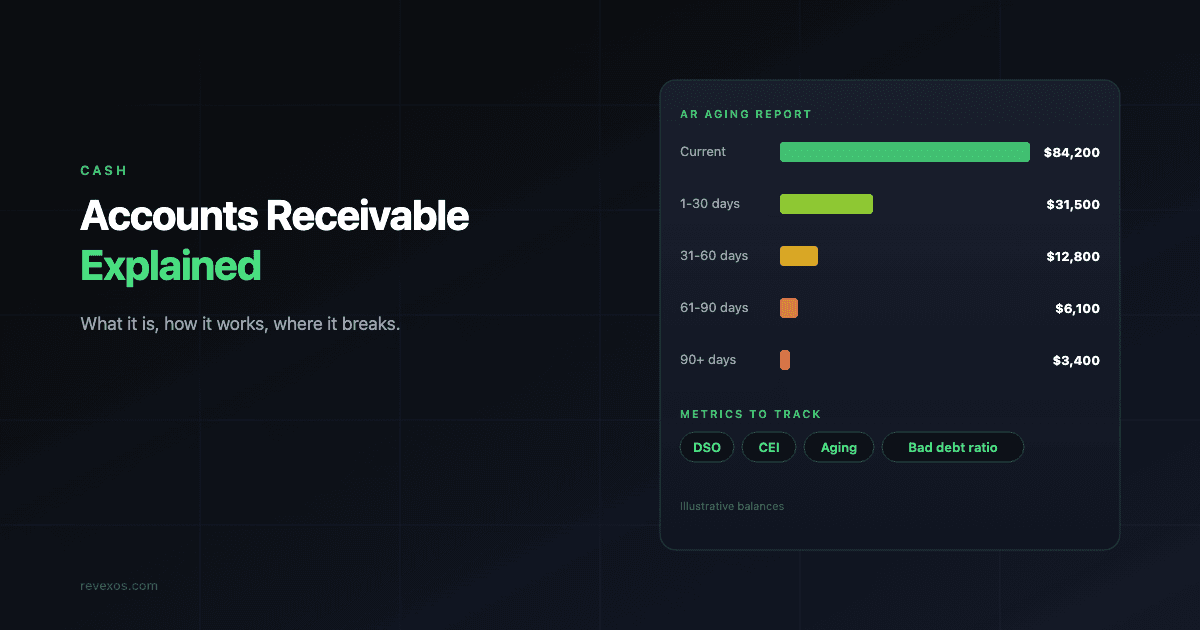
Breaks your outstanding AR into buckets by how overdue each invoice is:
- 0–30 days: Current or within terms - low risk
- 31–60 days: Mildly overdue - follow-up warranted
- 61–90 days: Significantly overdue - active collections required
- 90+ days: High risk of non-collection - escalation or write-off consideration
The aging report is your single most important AR management tool. The older an invoice gets, the less likely it is to be collected. Studies consistently show that invoices over 90 days have collection rates below 50%; invoices over 120 days drop below 25%.
Bad Debt Ratio
The percentage of AR written off as uncollectable.
Formula: Bad Debt ÷ Total Credit Sales × 100
Industry average for B2B is 1–2%. Consistently above 3% indicates systematic problems in credit screening, invoice accuracy, or collections follow-through.
Invoice Rejection Rate
The percentage of invoices that are rejected or returned for correction by customers. This metric is often not tracked because it happens outside the accounting system - the rejection comes via email or phone call and gets handled informally.
For professional services firms with enterprise clients, rejection rates of 15–25% are common when PO numbers, billing entities, and payment terms are not validated before invoices are sent. Each rejected invoice adds 20–30 days to the collection cycle for that invoice.
What Good AR Operations Look Like
The best AR operations share a consistent set of characteristics:
Invoices go out immediately. Not at the end of the month, not when someone remembers. The moment a service is complete or a product ships, the invoice generates and sends. Billing delays are one of the most fixable contributors to high DSO - every day of delay in sending the invoice is a day added to your collection cycle, guaranteed.
Follow-ups are systematic and sequenced. Day 1, Day 7, Day 14, Day 30. Each step is automated. The tone escalates proportionally. High-value accounts trigger a personal call at Day 7 instead of another email. The system runs whether or not anyone is thinking about it.
Cash application is automated. Payments are matched to invoices by amount, date, reference number, and customer history within minutes of receipt. Exceptions surface for human review. Everything clean closes automatically. Finance has an accurate picture of outstanding AR in real time, not two days after manual matching is complete.
Disputes are resolved fast. All relevant context - contract, delivery confirmation, PO, email thread - is available in one view the moment a dispute is flagged. Resolution takes hours, not weeks.
Credit risk is scored continuously. Customers are segmented by payment behavior, invoice aging patterns, and communication patterns. Finance can see which accounts are trending toward problem status before an invoice is missed, not after.
The Real Cost of Poor AR
Poor AR is not a back-office problem. It is a business problem.
When DSO is 60 days instead of 30 days, you need more cash on hand to cover operating costs while you wait for payment. That cash either comes from reserves (reducing your ability to invest in growth), credit lines (at interest cost), or investors (at dilution cost).
The math is direct:
- $2M/month in revenue at 60-day DSO = $4M of your own earned money sitting with customers at any given time
- Same business at 30-day DSO = $2M sitting with customers
- The difference = $2M of working capital freed up without adding a single new customer
That $2M is capital that could fund hiring, product development, marketing, or sit in the bank earning interest. Instead it is a silent tax on your business's growth capacity.
For companies with 25% invoice rejection rates - not uncommon in professional services - the DSO impact compounds further, because rejected invoices cycle back into the collection process after the correction delay.
How Automation Changes the Equation
Modern AR automation does not replace your finance team. It removes the manual work so they can focus on judgment and relationships instead of data entry and matching.
Automated cash application matches payments to invoices algorithmically, with machine learning that improves as it processes more transactions. Match rates of 85–95% are achievable for most businesses. The remaining exceptions are surfaced for human review with enough context to resolve in seconds, not hours.
Automated dunning runs on schedule regardless of whether anyone is thinking about it. The sequence is configured once. High-value accounts are routed to personal outreach triggers at the right escalation point. The system knows who owes what, prioritises by amount and age, and sends the right message at the right time.
AI-assisted dispute handling pulls the relevant context the moment a dispute flag appears. Finance sees the invoice, the contract, the delivery confirmation, and the relevant email thread in one view. Resolution time compresses from weeks to hours.
Continuous credit risk scoring processes payment history and communication behaviour into a risk score for every customer. The CFO sees the portfolio view in minutes. Problem accounts are flagged before they become write-offs.
The result: DSO drops 15–30 days, bad debt shrinks, and your finance team stops spending Monday mornings chasing Friday's payments.
If you want to try this yourself before deciding whether to build or buy, the free AR Prompt Playbook has copy-paste prompts for AR dashboards, collections outreach, and cash forecasts using the tools you already have.
For a practical breakdown of how to build this from the ground up, read How to Automate Accounts Receivable, or see RevExOS's AR automation service for what a fully built system looks like.
To find the gaps in your own AR process, work through the free DSO Reduction Checklist: 30 checks across terms, dunning, payment methods and disputes.