AR Automation Software vs. AR Automation Service: Which One Actually Fits Your Team
Stampli, Bill.com, Tipalti, and Versapay are tools you configure and run yourself. An AR automation service runs it for you, on the accounting stack you already have. Here's how to choose.
RevExOS
Q2C Consulting
Search "AR automation" and every result looks like a product page: sign up, connect your accounting system, configure your workflows, go live. That's the software model, and it's the only model most buyers know exists. It isn't the only one.
The other model is a service: a team (increasingly AI-assisted, sometimes with humans reviewing exceptions) that builds and runs the AR process for you, on top of the accounting system you already use, without you ever logging into a new tool. Both models solve the same underlying problem. They fit different teams for different reasons, and most comparison content doesn't say so plainly because most of it is written by the software vendors.
This isn't a "custom infrastructure vs. off-the-shelf tools" comparison - that's a separate question about whether you build and own a system yourself versus buying a SaaS tool. This is about who operates AR day to day once a system exists: you, using software, or a vendor, as a service.
What "AR Automation Software" Means
Stampli, Bill.com, Tipalti, Versapay, Gaviti, Chaser, Invoiced, Kolleno - these are all software. The shape is the same regardless of vendor:
- You sign a contract, usually per-seat or per-invoice-volume
- You (or your AR team) log into their platform and configure collection cadences, approval rules, and dunning templates
- You connect it to QuickBooks, Xero, or NetSuite, usually as a one-way or limited two-way sync
- Your team runs it: reviewing the queue, approving exceptions, adjusting templates when they stop working
- When something breaks - a customer disputes an invoice, a payment doesn't match, a cadence needs a one-off exception - your team handles it, inside the tool
You're buying a workspace, not an outcome. That's not a criticism; for a team with the internal capacity to own that workspace, it's often the right call - see the buyer framework in the software vs. custom infrastructure post for exactly when.
What "AR Automation Service" Means
An AR automation service - what RevExOS builds - inverts who owns the operating work:
- No new login, no seat license. The system is built directly on your existing QuickBooks, Xero, or FreshBooks account
- Collections cadences, dunning tone, and escalation rules are configured once, against your actual payment terms and customer relationships, not a generic template library
- Exceptions - disputed invoices, PO mismatches, a good customer who's suddenly gone quiet - are triaged and mostly resolved before they ever reach your team's inbox
- You get visibility (a dashboard, a weekly summary, whatever cadence you want) without doing the operating work yourself
You're buying a result: fewer overdue invoices, lower DSO, less time your team spends chasing. The tradeoff is the one every "software vs. service" decision comes down to: less configuration control, in exchange for not being the one who has to do the configuring, forever.
Side by Side
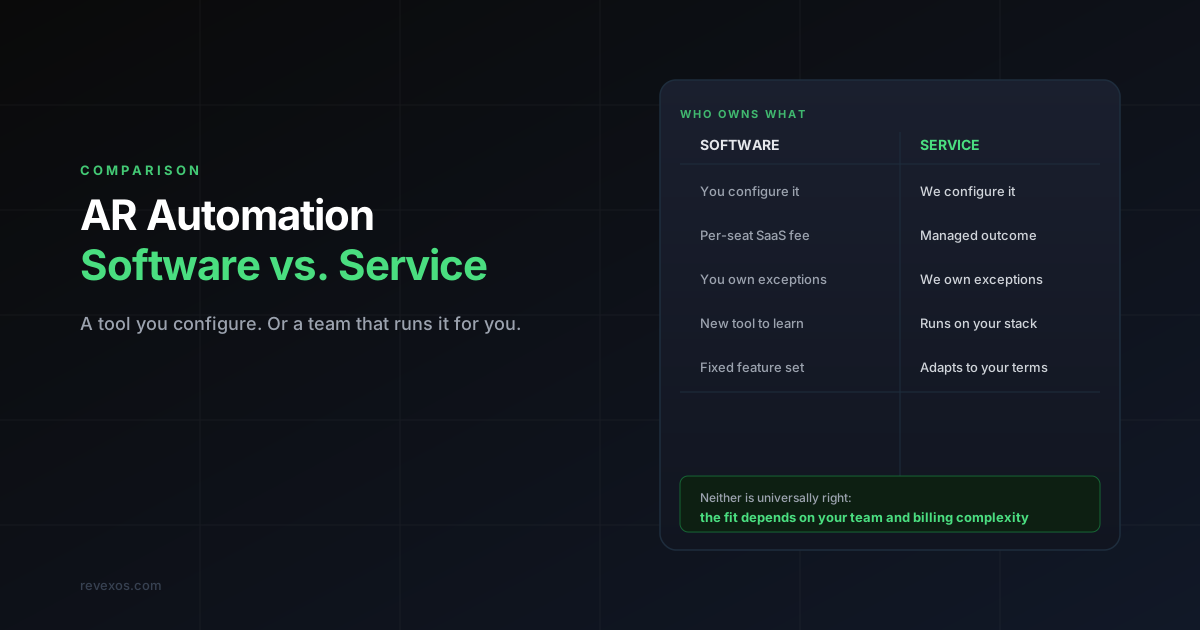
| AR Automation Software | AR Automation Service | |
| Who operates it day to day | Your team, inside the vendor's tool | The vendor, on your existing stack |
| Onboarding | Migrate workflows into a new platform | Built on the accounting system you already use |
| Pricing shape | Per-seat or per-invoice-volume SaaS fee | Managed fee tied to outcome or invoice volume |
| Exception handling | Your AR staff reviews and resolves | Triaged and mostly resolved before it reaches you |
| Customization | Configure within the tool's data model | Built around your actual billing and terms |
| Best fit | Teams with AR headcount and simple, consistent billing | Lean teams, or billing complex enough that "simple" doesn't describe it |
| What you're buying | A workspace | An outcome |
The Question That Actually Decides This
Not "which tool has better reviews" - "who do you want doing the collections work every single day?"
If you have (or plan to hire) AR staff whose job is to run a system, software is the right shape - you're paying for a workspace they'll live in. Gaviti, Chaser, and similar tools are built exactly for that team.
If you don't have dedicated AR headcount - a finance team of one, a founder still doing collections personally, an ops lead for whom AR is the fourth thing on their list - a service closes that gap without requiring you to hire for it or learn a new platform. This is also the more common shape for professional services firms and accounting firms managing AR across multiple client books, where the billing logic is too irregular for one team to standardize inside a single software configuration anyway.
What Doesn't Change Either Way
Both models still need:
- Clean, accurate invoice data at the source (garbage in, garbage out applies identically to software and service)
- A defined cadence - when a reminder goes out, when tone escalates, when a human gets looped in
- Someone accountable for DSO as a number the business tracks, not just a workflow that runs
Neither model is a substitute for fixing upstream data quality problems. If your invoices are wrong before they leave your building, no tool and no service recovers that time - see what actually causes AR problems for services businesses for the deeper version of that argument.
Frequently Asked Questions
Can I switch from software to a service later, or vice versa? Yes, in either direction, though moving away from software is easier since you're not migrating a system, you're just changing who operates the process on your accounting data. Moving from a service to software means standing up and configuring a new platform from scratch.
Is a service more expensive than software? Not necessarily. Per-seat software pricing can exceed a managed service fee once you count the internal headcount time spent configuring and babysitting the tool. Compare total cost of ownership, not just the sticker price of the subscription.
Do I lose visibility with a service model? No - a well-built service still gives you a dashboard or reporting cadence. What you give up is the day-to-day configuration screen, not visibility into what's happening with your AR.
What if my billing is genuinely simple - fixed retainer, one invoice a month per customer? Then a low-cost software tool is probably the most cost-effective option and a service is overkill. Simple, consistent billing is exactly the case where off-the-shelf software works well - see the full breakdown of when off-the-shelf tools are the right call.
If you want an honest read on which model fits your actual invoice volume and billing complexity, get in touch. No sales pitch, just the same framework applied to your numbers.