The Quote-to-Cash Problem: Why B2B Revenue Is Harder Than It Looks
Most B2B businesses think they have an invoicing problem. They actually have a quote-to-cash problem. This post explains the full Q2C cycle, where revenue leaks, and what RevExOS is built to fix.
RevExOS
Q2C Consulting
If you run a B2B business and your revenue feels harder to manage than it should, you are probably right - and the problem is not where most people look for it.
Most companies think they have an invoicing problem, or a collections problem, or a cash flow problem. In reality, they have a quote-to-cash problem: the entire chain of steps that converts a won deal into collected cash is broken in multiple places, and none of those breaks are visible until money is already late or missing.
This blog covers that problem in depth. This first post explains the full picture.
What Is Quote-to-Cash?
Quote-to-cash (Q2C) is the complete revenue cycle from the moment a deal closes to the moment cash lands in your account. It includes every handoff, system, and process in between:
- Quote and contract - pricing agreed, terms defined, contract signed
- Order management - delivery scheduled, work scoped, milestones set
- Billing and invoicing - invoice generated with correct amounts, terms, and recipient
- Collections and dunning - invoice sent, followed up, disputes resolved
- Cash application - payment matched to the correct invoice in your accounting system
- Revenue recognition - revenue recorded when the performance obligation is satisfied
In theory, this is a straight line. In practice, every handoff is a potential failure point - and most B2B businesses have broken handoffs in at least three of these six stages.
Where Revenue Actually Leaks
The obvious failures are visible: an invoice never sent, a payment chased for months. But most revenue leakage is invisible. It happens quietly, across many deals, in ways that never appear as a line item on any report.
Invoices that go out wrong. A deal closes with a PO number in the CRM. Finance generates the invoice from QuickBooks with a different contact. The invoice gets rejected by the client's AP system. Nobody knows for two weeks. That invoice now pays 30 days late - best case.
Scope changes that never reach billing. The delivery team agrees to an extra week of work. The project manager logs it in Jira. Finance is not copied. The next invoice goes out for the contracted amount. The extra work gets billed eventually (or never), always late.
Payment terms that drift. Your contract says Net 30. Someone set up the client in QuickBooks with Net 45. The client pays on their terms. You just gave every client two weeks of free credit without realising it.
Cash sitting unmatched. A payment arrives by bank transfer with no reference number. Your AR team spends two days trying to figure out which invoice it belongs to. During that time, the invoice shows as unpaid. Your DSO looks 48 hours worse than it actually is - multiplied across every payment that arrives without clean references.
Discounts that never end. You offered a 15% discount for the first three months to close a deal. Nobody set an end date. Twelve months later, the discount is still running.
None of these are catastrophic in isolation. Together, across 50 to 200 active clients, they represent 15 to 30 days of DSO - and on $1M of monthly revenue, that is $500K to $1M of your own money sitting uncollected at any given moment.
Why Standard Tools Don't Fix This
The market is full of point solutions. QuickBooks for accounting. HubSpot for CRM. Chaser or Gaviti for collections. Stripe for payments. Each tool does its job.
The gap is in the handoffs between them.
The native HubSpot QuickBooks integration syncs contacts and payments but cannot automatically generate an invoice from a closed deal with the correct PO, billing entity, and payment terms. The collections tools send reminders but cannot fix an invoice that was wrong before it left your building. The accounting system records transactions but does not know what was agreed in the contract.
When tools do not communicate, humans fill the gap - manually, inconsistently, and at 4pm on a Friday.
Off-the-shelf AR automation software handles collections workflow well for simple billing models. But for professional services firms, SaaS companies with complex pricing, or any business where billing logic is non-trivial, it sits on top of a broken data model and automates the wrong thing.
What Actually Fixes It
The fix is not a new tool. It is connecting the tools you already have with the logic that encodes how your revenue actually works.
That means:
- When a deal closes in your CRM, the invoice generates automatically with the right data
- When a payment arrives, it matches to the right invoice without manual reconciliation
- When a contract changes, billing adjusts before the next cycle rather than after
- When an invoice would be wrong, it gets flagged before it reaches the client
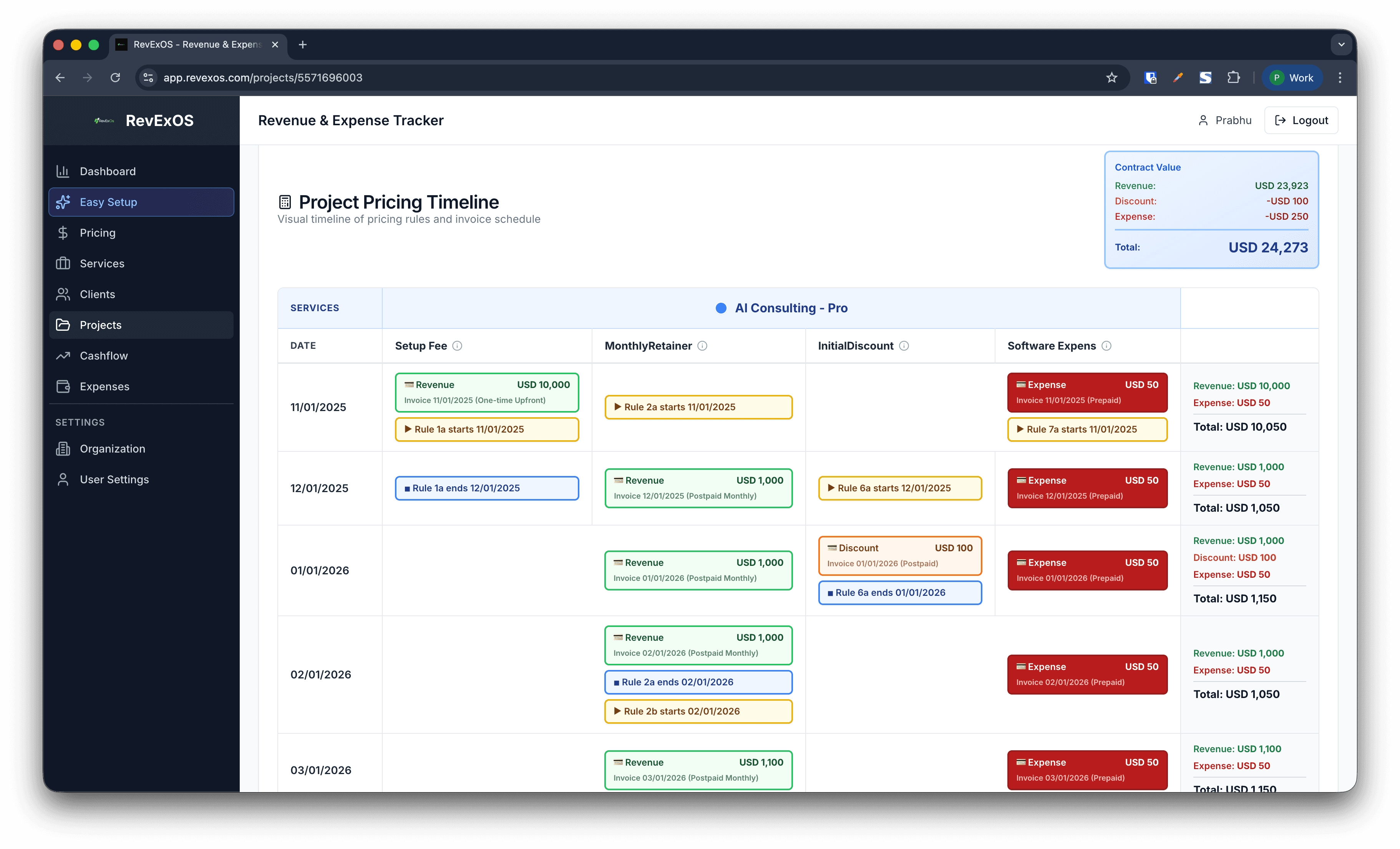
This is what we build at RevExOS. Not a SaaS product you subscribe to and configure yourself - an implementation that connects your specific CRM, billing engine, accounting system, and payment workflow into a single revenue cycle that runs without manual intervention.
What This Blog Covers
Every post on this blog is built around the operational reality of B2B revenue: what actually goes wrong, why, and how to fix it systematically.
You will find:
Deep dives into AR automation - what accounts receivable actually is, how to automate the full AR cycle, why DSO gets high and how to reduce it, and the limits of off-the-shelf AR tools.
Integration guides - specifically how HubSpot and QuickBooks fail each other and what a working invoice automation setup looks like.
Revenue recognition - ASC 606 explained for professional services, how modern SaaS pricing breaks RevRec, and what to do about it.
Industry-specific guides - AR automation for agencies and consulting firms and what makes professional services different from product companies.
Who This Is For
The content here is written for finance leaders, CFOs, RevOps practitioners, and operators at B2B companies - typically $2M to $50M ARR - who are responsible for the revenue cycle and want to understand it more deeply and operate it more effectively.
You do not need to be an accountant to find this useful. The goal is operational clarity: what is happening in your revenue cycle, why, and what to do about it.
If you find something useful, share it. If you have a question about your specific setup, ask me.
RevExOS is a free learning hub for automating the path from won deal to collected cash: guides, tools and real projects.
 QuickBooks Online
 HubSpot