Claude in Salesforce: What the Anthropic-Salesforce Partnership Means for Quote-to-Cash
Salesforce made Claude available across Agentforce, Slack, and Tableau. Here's what that actually changes for sales and revenue teams, and the gap it still leaves between a closed deal and collected cash.
RevExOS
Q2C Consulting
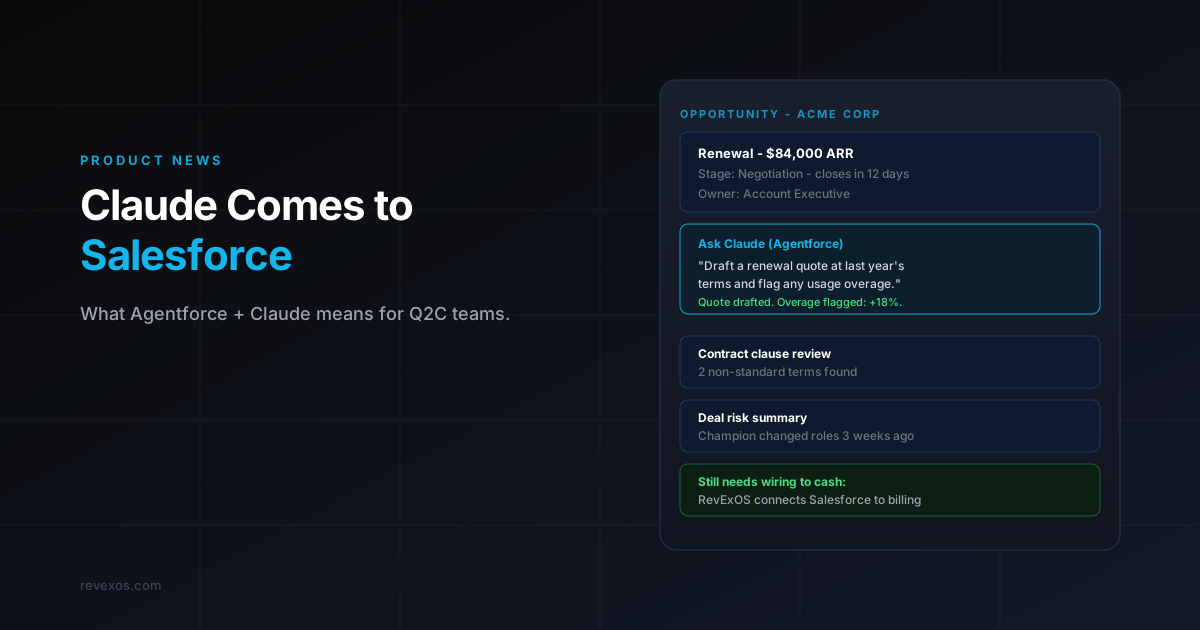
Some people have started calling it "ClaudeForce." That's not an official name, Salesforce and Anthropic haven't branded it that way, but it's a fair shorthand for what changed: Claude is now available as a model choice across the Salesforce platform, including Agentforce (Salesforce's AI agent builder), Slack, and Tableau. For a site built around quote-to-cash automation, that's directly relevant, because Salesforce is where a huge share of B2B deals live before they ever touch an invoice.
This post covers what actually changed, what it means for revenue and RevOps teams specifically, and why having Claude reason inside your CRM still leaves the exact gap RevExOS exists to close.
What Changed
Salesforce and Anthropic expanded their partnership to put Claude models directly inside the tools revenue teams already use, instead of requiring a separate integration or middleware layer:
- Agentforce. Salesforce's platform for building and deploying AI agents added Claude as a selectable foundation model. Teams building custom agents for sales, service, or operations can now choose Claude specifically for tasks that benefit from its reasoning and long-context strength: contract review, multi-step research, and drafting that needs to sound like a specific person or account context rather than a generic template.
- Slack. Slack, owned by Salesforce, already had a Claude integration; the deeper partnership extends that reach so Claude can act on Slack conversations with more context from the rest of the Salesforce ecosystem.
- Tableau. Natural-language analytics gets Claude as an option for interpreting a question about a dataset and generating the underlying query or visualization, rather than requiring someone to build the dashboard first.
The significance isn't a single feature. It's that Claude is no longer something you have to bolt onto Salesforce with a custom API integration, it's a model option inside the tools your sales and ops teams already have open all day.
What This Means for Sales and RevOps Specifically
If you run a CRM-based sales motion, three use cases matter more than the rest:
1. Quote and proposal drafting with real context. An agent that can read the opportunity record, the account's contract history, and prior email threads can draft a renewal quote at the right terms without a rep manually pulling all of that together first. This is the same judgment layer this site has written about before in how Claude automates the full quote-to-cash cycle: the value isn't that the AI can type a quote, it's that it can decide what the quote should say based on account-specific facts.
2. Contract clause review before a deal closes. Non-standard terms, unusual payment schedules, and liability language that doesn't match your standard paper are exactly the kind of pattern-matching-plus-judgment task an LLM is good at and a rules engine is not. Catching this inside the CRM, before the deal is marked Closed Won, is earlier and cheaper than catching it after the contract is signed and the invoice is already wrong.
3. Deal risk summarization. "This champion changed roles three weeks ago" or "this account's last two renewals both slipped past the close date" are the kind of signals that live scattered across activity logs and email threads. An agent that can synthesize that into one flag on the opportunity record catches risk earlier than a manager reviewing the pipeline in a weekly forecast call.
The Gap This Doesn't Close
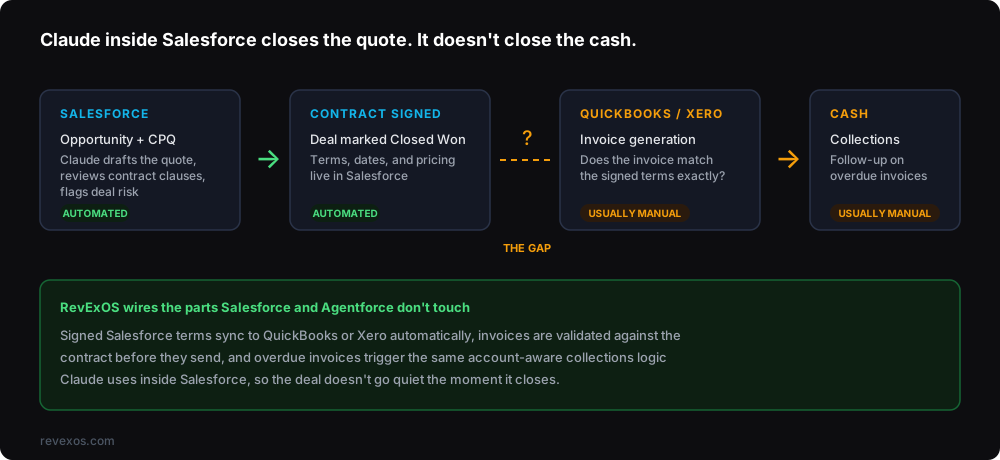
Here's the part that matters most for a Q2C-focused audience: everything above happens before the deal closes. Once a contract is signed in Salesforce, the work of turning that agreement into cash, generating the correct invoice, syncing renewal dates, following up on anything overdue, still depends on whatever connects Salesforce to your accounting system. Agentforce doesn't natively own that handoff, and most teams don't have it wired end to end.
That gap shows up in a few predictable ways:
- The invoice that goes out doesn't match the negotiated terms in the signed contract, because the accounting team is billing off the original quote, not the final redline.
- A multi-year deal with a built-in price escalation renews at the old rate because nothing pushed the updated terms from Salesforce into the billing system.
- An overdue invoice sits with no follow-up because the collections process lives in a spreadsheet the sales team never sees, even though the account context, and the same kind of AI reasoning about tone and relationship value, already exists on the Salesforce side.
This is precisely the workflow this site's Claude collections automation guide and AR Collections Email Generator are built around: applying the same account-aware judgment to the AR side that Agentforce now applies on the sales side. The two need to be connected, not separate.
Where RevExOS Fits
RevExOS builds the wiring between Salesforce and your accounting stack (QuickBooks, Xero, or NetSuite) so that a signed deal actually becomes a correct invoice, and an overdue invoice actually gets followed up on, without a person manually re-keying terms or checking a spreadsheet. Whether your sales team is using Agentforce, a Salesforce flow, or no AI at all yet, the underlying problem is the same one we've been solving since before this partnership existed: the handoff between systems is where revenue gets stuck, not the intelligence inside any one of them.
If your Salesforce and accounting systems already drift out of sync, whether or not Claude is involved on the sales side, that's exactly the audit we run for free.
Get a free Q2C audit and see where your Salesforce-to-cash handoff is leaking, or read more on connecting your CRM to your accounting stack.