The Metering Architecture Problem: Why AI Agent Loops Break Your Billing System
Agentic AI workloads break the one-request-one-event assumption every metering pipeline was built on. Here is the architecture that holds up: idempotency keys, event sourcing, and separating rate-limiting from the billing source of truth.
RevExOS
Q2C Consulting
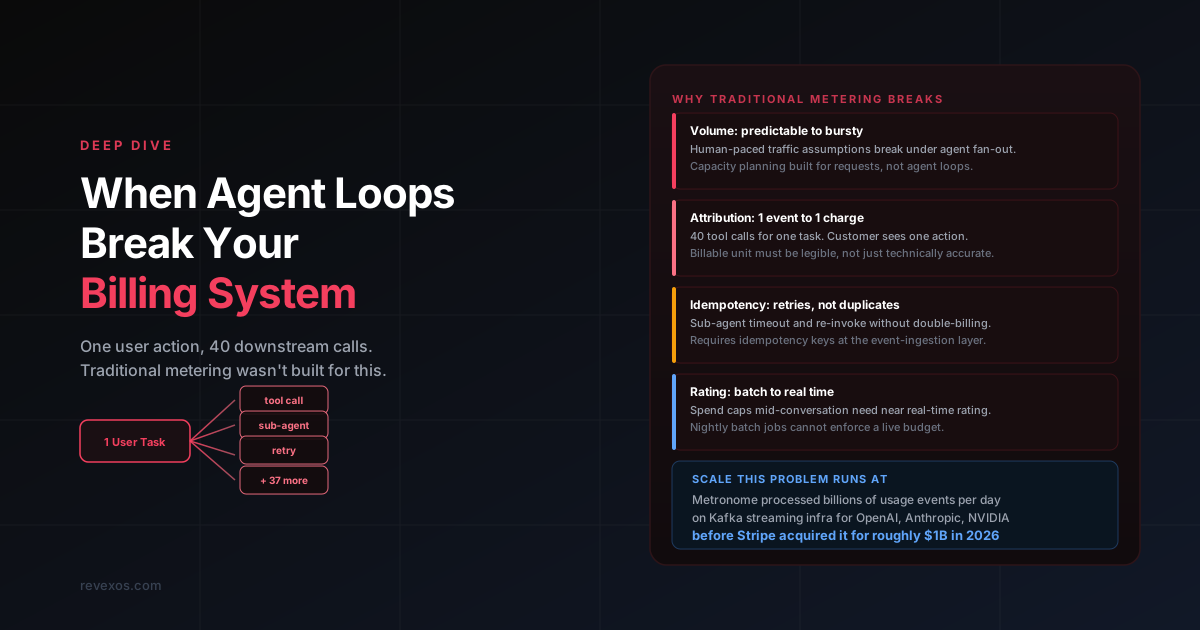
If you built your usage metering pipeline before agentic AI features shipped in your product, it was almost certainly built on an assumption that is now false: one customer-initiated request produces one billable event.
A user clicks a button, your backend calls an API, that call returns a token count, you write a usage row, you rate it, it shows up on an invoice. Clean attribution, predictable volume, one event in, one event out. That model held for a decade of API metering, and most billing infrastructure, including plenty of homegrown systems still running in production, was built directly on top of it.
Agent loops break the model structurally, not incidentally. A single user action ("summarize this contract," "resolve this support ticket," "research this account") can now trigger a planning step, a handful of tool calls, one or more sub-agent invocations, retries when a tool fails or a model self-corrects, and a final synthesis call, each one a separate metered event, each with its own token cost, and none of them visible to the user as a distinct action. The user sees one request. Your billing system sees an unpredictable fan-out of ten, fifty, or three hundred downstream events, and it has to correctly attribute every one of them back to the right customer, feature, and invoice line item, or your unit economics and your invoices are both wrong.
This is an infrastructure problem, not a pricing problem. You can have the cleanest pricing model in the world, per-token, per-action, hybrid credits, and still lose money and customer trust because the plumbing underneath it cannot handle how agentic workloads actually generate usage. This post is about that plumbing.
For the business-side framing of the token billing problem, see our guide on how AI companies bill for token usage: metering, rating, and revenue recognition explained. This post is the engineering layer underneath it.
Why the Old Model Breaks: Request Versus Event
The core failure is a conflation that used to be harmless: treating "the thing the customer did" and "the thing you bill for" as the same object.
In a traditional API metering system, they are the same object. Customer calls /generate-report, you meter one call to /generate-report. The request is the event.
In an agentic system, the user-visible action is a coordination point, not a billable unit. Underneath a single "resolve this ticket" action, an orchestrating agent might call a retrieval tool three times, invoke a sub-agent to draft a response, call a second sub-agent to check that response against policy, retry the check after a timeout, and finally call the model once more to produce the customer-facing output. That's six to eight separate LLM calls and tool invocations, each consuming tokens, each a candidate billable event, all triggered by one click.
Two consequences follow immediately. The event count is no longer bounded by request count: your metering pipeline has to handle a many-to-one relationship between billable events and user actions, and the ratio varies by task complexity, retry count, and which sub-agents got invoked. A pipeline sized for "one event per request" will be under-provisioned the first time a customer's workload triggers a wide fan-out.
And the attribution chain gets longer and more fragile: every downstream call needs to carry enough context to be traced back to the originating customer and account, not just the immediate caller. If a service boundary somewhere in that chain drops the customer context, you now have usage you can't attribute. It either gets written off, or, worse, billed to the wrong account.
This is the shift the rest of this post works through: four specific technical problems, and the architectural patterns that hold up against them.
Problem 1: Event Attribution Across a Fan-Out
When a single user action fans out into dozens of downstream calls across multiple services (your orchestrator, a retrieval service, two or three sub-agents, external tool APIs), every one of those calls needs to be reliably tagged with the originating customer, account, and request before it reaches the metering layer. Miss this and you either can't bill the usage at all, or you attribute it to the wrong place, both of which show up as revenue leakage or a customer dispute.
The pattern that works is context propagation as a first-class part of the call contract, not something bolted on after the fact. Every internal call in the agent loop, tool invocation, sub-agent call, retry, carries a structured context object: a stable root request ID generated once at the top of the loop and passed unchanged through every downstream call, the customer/account ID and any relevant feature or plan identifier, and a span ID for the specific call, so you can distinguish "this token cost came from the retrieval step" from "this token cost came from the policy check."
This is the same shape as distributed tracing (OpenTelemetry trace and span IDs), and that's not a coincidence, it's the same problem: usage attribution in an agent loop is distributed tracing applied to billing instead of latency debugging. If your team already has tracing instrumented for observability, extend it to carry billing context rather than building a parallel system. You'll need the trace tree to answer "why was this invoice line item $340 and not $40" when a customer asks.
The failure mode to design against: a service in the middle of the chain that doesn't propagate context because its author didn't think of it as billing-relevant. Treat context propagation as a CI-enforced requirement on any service that can be invoked from an agent loop, not a convention people are supposed to remember.
Problem 2: Idempotency and Duplicate Events
Agent loops retry. A tool call times out and the orchestrator retries it. A model call gets a malformed response and the agent self-corrects by calling again. A network blip causes your own service to resend a request it thinks failed. Every one of these retries is a legitimate operational behavior, and every one of them is also a mechanism for generating a duplicate usage event if your metering layer isn't built to catch it.
Without deduplication, a retried tool call gets metered twice: once for the attempt that timed out (but which may have actually completed and consumed tokens on the provider side before the timeout), and once for the retry. Multiply that across an agent loop with a dozen tool calls, some fraction of which retry under normal operating conditions, and you get systematic overbilling that's invisible until a customer's finance team reconciles your invoice against their own usage logs and files a dispute.
The fix is idempotency keys on every metered event, enforced at write time, not reconciled after the fact. Every event that could be metered gets a stable, deterministic event ID generated at the point of the call, not at the point of logging, so the same logical call happening twice (original plus retry) produces the same event ID both times. The metering layer's write path should be INSERT ... ON CONFLICT DO NOTHING (or the equivalent in your event store) keyed on that event ID, not a blind append, so duplicate writes are dropped at ingestion rather than caught later in a batch job. And the key needs to survive the retry: generated once at the top of the operation being retried and passed through, not regenerated on each attempt. A key that changes on retry defeats the entire mechanism.
The expensive alternative to building this correctly is doing what a lot of teams do by default: meter everything, then run a reconciliation job that tries to detect and back out duplicates after the invoice period closes. This works, technically, but it means every billing cycle includes a manual cleanup step, it erodes trust with customers who see corrected invoices, and it doesn't scale as event volume grows. Idempotency at the write path is cheaper to build once than reconciliation is to run forever.
Problem 3: Burst Volume and Real-Time Versus Batch Rating
Traditional API traffic is comparatively smooth: request volume tracks user activity, which has predictable daily and weekly patterns. Agent loops don't behave that way. A single customer kicking off a batch research task, or a scheduled agent job running against a large document set, can generate a burst of thousands of metering events in a span of seconds, then go quiet. Your metering pipeline has to absorb that burst without falling over, for many customers whose burst patterns are uncorrelated with each other.
This is exactly the scale problem that pushed usage-based billing infrastructure toward streaming architectures in the first place. Metronome's infrastructure prior to its acquisition, it was the metering layer behind OpenAI, Anthropic, Databricks, and NVIDIA, processed billions of usage events per day on Kafka-based streaming pipelines specifically because naive approaches, writing usage rows to a relational database directly on the request path, fall over under this kind of burst load. A relational database with synchronous writes on the hot path becomes the bottleneck the moment a handful of large customers run agent workloads concurrently; a log-based streaming system absorbs bursty, high-volume writes and lets downstream consumers process at their own pace. We cover what happened to that infrastructure, Stripe's roughly $1 billion acquisition of Metronome, expected to close in early 2026, in our comparison of Stripe, Metronome, Orb, and Amberflo, which covers the deal.
The architectural question this forces is one you need to answer explicitly: does rating need to happen in real time, or can it be batched? The honest answer is usually both, for different purposes. Real-time or near-real-time rating is required for spend controls and guardrails: if you offer a hard spend cap, or need to cut off a runaway agent loop before it burns through a customer's monthly budget in one session, you need a fast path that can answer "how much has this customer spent right now" with low latency, even if the number isn't final. Batch rating is usually sufficient, and cheaper, for the source-of-truth billing pipeline: tiered pricing rules, currency conversion, and invoice line items don't need to happen synchronously with the usage event. Batching this work, hourly or at billing-period boundaries, lets you apply more complex rating logic without needing it to keep up with burst traffic in real time.
Trying to make one system do both jobs well is where a lot of metering architectures get stuck. The pragmatic pattern is a fast, approximate real-time counter (often just an incrementing counter in a low-latency store, keyed by customer and period) that's good enough for guardrails, sitting alongside a durable event log that's the actual source of truth for billing and gets rated in batch. The two should agree closely, but they don't need to be the same code path, and trying to force them to be usually means the guardrail path is too slow or the billing path is too fragile.
Problem 4: Partial and Failed Completions
An agent loop that gets interrupted, hits a rate limit mid-chain, or fails on a tool call three steps into a five-step plan has still consumed real tokens and real compute before it stopped. The customer didn't get a completed result, but the usage happened, and someone has to decide what to do with the metering record for it.
There is no universally correct answer here, it's a product and pricing decision as much as an engineering one. But the engineering requirement is the same regardless of which policy you choose: the metering layer has to record partial usage at the point it occurs, not assume it can reconstruct it after the fact from a completed-request log. If your metering only fires on successful completion of the full agent loop, you lose visibility into everything that happened before the failure, which means you can't bill for it even if your pricing model says you should, and you also can't diagnose cost anomalies, a customer whose loops fail repeatedly at step 3 is burning your compute budget in a way that never shows up if failed loops don't emit events.
The practical fix has three parts. Meter at each completed step or tool call, not just at final task completion, so a five-step agent loop that fails at step 3 has emitted three metering events, not zero. Tag each event with the outcome of its own step, succeeded, failed, retried, so downstream rating logic can decide how to treat it, rather than trying to infer outcome from the absence of a final "task complete" event. And decide explicitly, as a pricing policy encoded in your rating rules rather than left to whatever your metering happens to capture, whether failed steps are billed at full cost, discounted, or credited.
The failure mode to avoid is architecture that makes this decision for you by default, because it only knows how to talk about "requests" that completed. Agent loops fail partway through often enough that this isn't an edge case, it's a routine operating condition your metering has to handle as a first-class path, not an exception handler bolted on later.
The Architecture Patterns That Hold Up
Pulling the four problems together, one addition matters beyond what's already been covered: event-sourcing over mutable counters. Store usage as an append-only log of immutable events, each with its own ID, timestamp, and full context, not as a running total that gets incremented. Mutable counters lose the ability to answer "what exactly happened" when a customer disputes a bill, and they make deduplication and re-rating far harder. An append-only log lets you replay, re-rate, and audit after the fact, which matters more with agentic usage than it ever did with simple API metering, because agent loops are exactly the kind of complex, multi-step usage pattern customers are most likely to question.
The other three patterns, idempotency keys, separating the real-time guardrail path from the batch source of truth, and treating reconciliation between "what we metered" and "what we billed" as an ongoing, automated process rather than a one-time migration concern, are covered above. None of these four patterns are exotic. Idempotency keys, event sourcing, and separating fast paths from source-of-truth paths are established distributed-systems techniques. What's changed is that agentic AI usage makes skipping them expensive in a way that simple, low-volume API metering never did: the fan-out, burst, and partial-completion patterns are common enough in agent workloads that the naive approach breaks in production, not in a hypothetical edge case.
If your team is also thinking about how this metering layer plugs into the rest of the quote-to-cash stack, CRM, CPQ, invoicing, revenue recognition, our guide to how Claude automates the full Q2C cycle covers where an AI layer sits on top of that infrastructure once the metering and rating problems below it are solved.
Where to Start
The sequencing that avoids the most pain: fix attribution first, since everything downstream depends on it. Add idempotency keys before you scale volume, it's cheaper to build deduplication into the write path now than to run reconciliation jobs forever or explain a corrected invoice to an enterprise customer's finance team. Decide your real-time versus batch split deliberately rather than letting it default based on whatever your current database can handle. And build reconciliation as a standing process from day one, even at low volume, so it's not a scramble once discrepancies start costing real money.
None of this shows up on a product demo. It's the layer underneath the demo that determines whether your invoices are correct, whether your unit economics are trustworthy, and whether you can answer a customer's dispute with a full trace instead of a shrug. For agentic AI products, it's no longer optional infrastructure, it's the thing that decides whether usage-based pricing actually works at the volume agent loops generate.