Stripe vs Metronome vs Orb vs Amberflo (2026 Guide)
Compare usage-based billing platforms after the Stripe-Metronome acquisition: pricing, metering architecture, and which one fits AI token billing.
RevExOS
Q2C Consulting
If you are building an AI product, a usage-based SaaS product, or anything priced on consumption rather than seats, you will eventually evaluate this exact set of four platforms. The reason is not marketing. It is that these are the four vendors that have actually solved the hard parts of metering, rating, and invoicing usage at scale, and each one solved a slightly different version of the problem.
We covered the mechanics of token metering, rating, and revenue recognition in our pillar overview on how AI companies bill for token usage. This post is the deep dive that follows from it: a direct, practical comparison of the four platforms companies actually shortlist when they need to price and bill on usage, with a fifth complication now baked in - Stripe's acquisition of Metronome, which collapses two of these four options into one.
This is not a generic feature-matrix post. It is what the comparison looks like once you get past the marketing pages: architecture, what each platform is actually best at, where each one breaks down, and who should choose which.
The Landscape, in One Sentence Each
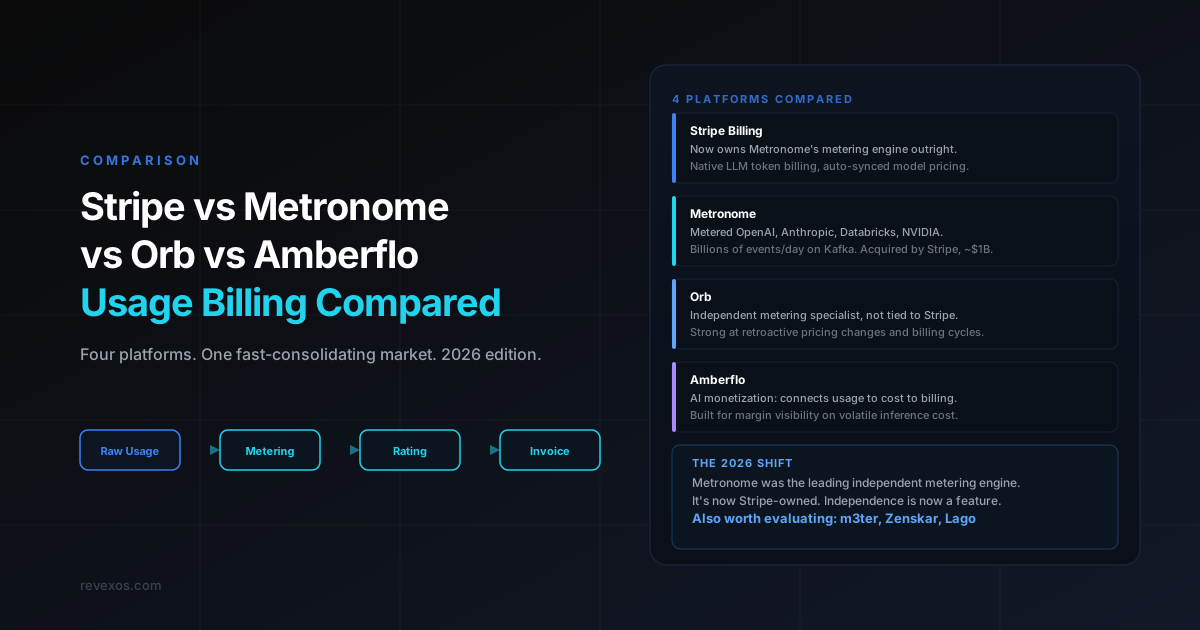
Stripe Billing is the payments and invoicing layer for a huge share of SaaS and AI companies, extended into usage-based billing and, as of March 2026, native LLM token billing with auto-synced pricing for OpenAI, Anthropic, and Google models.
Metronome was the metering layer behind OpenAI, Anthropic, Databricks, and NVIDIA, built on Kafka-based streaming infrastructure to process billions of usage events a day. It is now part of Stripe.
Orb is a metering and billing-cycle specialist built to be paired with whatever invoicing and payments stack you already run, with particular strength in retroactive pricing changes.
Amberflo is not really a billing platform in the traditional sense. It is an AI monetization platform that connects usage to underlying compute cost to billing in one view, so you can see margin, not just revenue.
Those five sentences are the whole comparison in miniature. Everything below is the detail behind them.
The Stripe-Metronome Acquisition Changes the Frame
Before going further, one fact reshapes this entire comparison: Stripe acquired Metronome for approximately $1 billion, a deal that closed in early 2026. That means two of the four platforms in this comparison's title are now the same company.
Why Stripe wanted it: Metronome's real strength was never raw metering. It was committed-use contracts, where an enterprise customer commits to, say, $50,000 a month at a discounted rate, draws the commitment down as usage accrues, burns prepaid credits along the way, and only pays overage once the commitment is used up. Tracking that in real time across many customers with different tiers, renewal dates, and credit balances is much harder than metering seats, and it is a large part of why OpenAI, Anthropic, Databricks, and NVIDIA chose Metronome. Stripe had already shipped LLM token billing in preview in March 2026 (auto-synced token prices for OpenAI, Anthropic, and Google models); buying Metronome meant not having to build the hard commitment-and-credit layer from scratch.
| Before the acquisition | After the acquisition | |
|---|---|---|
| Payments | Stripe | Stripe |
| Subscription billing | Stripe Billing | Stripe Billing |
| Enterprise usage metering | Independent specialists (Metronome, Orb, m3ter, Amberflo) | Metronome inside Stripe; Orb, m3ter, Amberflo, Zenskar, Lago are the independent alternatives |
| Single-vendor full stack | Did not really exist | Stripe payments + billing + metering, one contract |
| The buyer's question | "Which metering specialist fits our volume and rating complexity?" | "One vendor for money movement and metering, or deliberately keep them separate?" |
If you already run on Metronome, three things are worth raising with your account team rather than assuming: how the roadmap bends toward Stripe integration (shared customer, payment, and invoicing objects), vendor concentration now that payments, subscriptions, and metering are one relationship, and what changes in data handling, since usage events reveal customer-level usage, cost structure, and margin. None of this is a reason to migrate reflexively; it is a reason to re-run the evaluation that justified the original choice.
If you are choosing now: expect a 12 to 18 month integration window where Metronome's independent roadmap slows, treat vendor concentration as a real criterion rather than a footnote, and evaluate at least one independent specialist alongside Stripe even if you expect to pick Stripe, so you see what you would give up on real-time rating depth, AI cost attribution, and data portability. The capability to test every vendor on, Stripe included, is multi-tier committed-use contracts with prepaid credit draw-down, mid-contract changes, and real-time balance visibility for the end customer.
For the purposes of this comparison, the practical implication is this: evaluating "Stripe Billing vs. Metronome" as two independent options no longer makes sense for a new implementation. What you are actually choosing between is Stripe's native usage billing (increasingly absorbing Metronome's metering engine and enterprise commitment logic) versus Orb, versus Amberflo, versus a handful of newer entrants. Our Stripe page covers what usually breaks when Stripe is the billing layer, whichever metering engine sits underneath.
We are keeping Metronome in this comparison for two reasons. First, plenty of companies are already running on Metronome and need to understand what "part of Stripe" means for their existing implementation. Second, understanding what Metronome was built to do, independent of the acquisition, tells you what capability now sits inside Stripe's stack and what a Stripe-first strategy inherits.
What Each Platform Was Actually Built For
Stripe Billing's origin is payments. It became the default invoicing and subscription layer for tens of thousands of SaaS companies before usage-based pricing was common, and it has extended outward from that foundation rather than being built usage-first. The strength this gives Stripe is not sophistication in metering, it is reach: if you already use Stripe for payments, adding usage billing is a configuration change against infrastructure you already trust, not a new vendor integration with its own auth, webhooks, and reconciliation process. The March 2026 LLM token billing preview is a direct expression of this strategy - Stripe auto-syncs token prices for OpenAI, Anthropic, and Google models so an AI company reselling model access does not have to hand-maintain a pricing table that changes every few weeks.
Metronome was built by people who metered usage at hyperscale AI labs before "AI billing" was a category. Its architecture is Kafka-based event streaming designed to ingest and rate billions of events per day without falling behind. What made Metronome the default choice for OpenAI, Anthropic, Databricks, and NVIDIA was not the invoice output, it was the metering pipeline underneath: real-time aggregation, complex commitment and credit-burn-down logic, and the ability to handle enterprise contracts with prepaid commits, overage tiers, and multi-product credit pools that draw down against a single balance.
Orb was built as a metering and billing-cycle specialist that assumes you already have an opinion about invoicing, payments, or your general ledger, and just want the usage-rating layer done well. Its standout capability is handling retroactive pricing changes cleanly: if you need to re-rate historical usage after a pricing model changes, correct a metering bug after the fact, or apply a new tier structure to a past billing period, Orb's data model is built for that without requiring you to reconstruct invoices by hand. Orb is deliberately not trying to be your payments processor or your CRM-to-cash system; it expects to sit next to one.
Amberflo starts from a different question entirely. Instead of "how do we meter usage and generate an invoice," Amberflo asks "how do we connect usage to the cost of serving that usage, and then to the price we charge for it, in one place." For a SaaS company that resells inference or GPU compute, that distinction matters enormously: a pure metering-then-billing platform can tell you what you billed a customer, but it cannot tell you, in the same view, what that customer cost you to serve. Amberflo's positioning as an "AI monetization" platform, not a billing platform, comes directly from building cost-of-goods and margin visibility into the core product rather than treating it as a downstream analytics problem.
Platform Comparison: Core Capabilities
| Capability | Stripe Billing | Metronome (now Stripe) | Orb | Amberflo |
|---|---|---|---|---|
| Primary strength | Payments + invoicing reach | Enterprise commitments, high-volume metering | Retroactive rating, billing-cycle flexibility | Usage-to-cost-to-margin visibility |
| LLM token billing (native) | Yes, preview since March 2026, auto-synced OpenAI/Anthropic/Google pricing | Yes, pre-acquisition strength now folding into Stripe | Configurable, not native token-price sync | Configurable, built for AI cost modeling |
| Event ingestion scale | Growing, backed by Stripe infra | Billions of events/day (Kafka streaming) | High volume, batch and near-real-time | High volume, cost-linked aggregation |
| Enterprise commitments and credit pools | Improving via Metronome integration | Best-in-class, purpose-built | Supported | Supported |
| Retroactive pricing changes | Limited | Limited | Best-in-class | Supported |
| Cost-to-margin visibility | No | No | No | Core differentiator |
| Standalone invoicing/payments | Yes, native | No, relies on integration | No, pairs with existing stack | No, pairs with existing stack |
| Best paired with | Nothing extra needed | Now effectively Stripe | Existing billing/invoicing system | Existing billing/invoicing system |
The row that matters most for AI companies specifically is cost-to-margin visibility. Stripe, Metronome, and Orb are all, at their core, usage-to-invoice engines. Amberflo is a usage-to-cost-to-invoice engine. If your board is asking what your gross margin looks like per customer once you account for the underlying inference or compute spend, only one of these four platforms answers that question natively.
Metering and Rating: Head to Head
| Factor | Stripe Billing | Metronome | Orb | Amberflo |
|---|---|---|---|---|
| Real-time rating | Improving, not the historical strength | Yes, real-time via streaming pipeline | Near real-time | Real-time, cost-aware |
| Tiered/volume pricing | Yes | Yes | Yes | Yes |
| Prepaid commitments and credit burn-down | Basic, strengthening post-acquisition | Advanced, purpose-built | Supported | Supported |
| Multi-product credit pools | Limited | Yes | Supported | Supported |
| Custom rating logic | Configuration-based | Configuration and API-driven | Configuration-based, strong on re-rating | Configuration-based, cost-model-aware |
| Integration surface if already on Stripe | Minimal, it's native | Now inherited via Stripe | New vendor, new integration | New vendor, new integration |
The practical read here: if you already run payments through Stripe, the integration cost of adding Stripe's usage billing is close to zero, which is a real advantage even where the rating engine itself is not yet as mature as Metronome's was standalone. If you need enterprise-grade commitment and credit handling today, not "eventually as Stripe integrates it," Orb and Amberflo are the more proven options outside the Stripe ecosystem.
Integration and Implementation Reality
Stripe Billing integrates fastest for companies already using Stripe for payments. If you are not on Stripe, you are taking on a full payments migration in addition to a billing migration, which is a much bigger project than it appears from the pricing page.
Metronome, now inside Stripe, is in a transitional state. Existing Metronome customers should expect continuity in the near term but should watch for how deeply the metering engine gets merged into Stripe's own product versus kept as a semi-independent layer. New implementations evaluating "Metronome" in 2026 are, in practice, evaluating Stripe's roadmap.
Orb integrates as a metering and rating layer alongside your existing invoicing, payments, and GL stack. This means more integration points than an all-in-one platform, but also means you are not locked into a single vendor's payments processor or invoicing templates. Companies that already have opinions about their payments stack (for example, running Stripe for payments but wanting a more sophisticated rating engine than Stripe's native offering) often land here specifically to keep Orb and their payments layer decoupled.
Amberflo integrates similarly to Orb, as a layer alongside existing billing infrastructure, but with additional integration work to pull in cost data: cloud compute bills, GPU costs, or per-token inference costs from your model providers. That extra integration is the price of the margin visibility Amberflo provides, and it is meaningfully more setup work than a pure metering-to-invoice pipeline.
If your usage volume is in the hundreds of millions of events a month and you are already running on SAP, or you need Salesforce-native subscription management alongside your usage billing, none of these four platforms is really the right comparison set. See our SAP BRIM vs. Zuora comparison instead - that is the enterprise-scale conversation, not the usage-billing-platform conversation.
Also Worth Evaluating
The four platforms above are the ones that come up in nearly every usage-based billing evaluation, but they are not the only credible options.
m3ter focuses heavily on metering accuracy and scalability, and tends to show up in shortlists for infrastructure and developer-tooling companies where usage events are high-volume and technically complex to define correctly.
Zenskar and Lago both position as unified subscription-plus-usage platforms - trying to cover recurring billing and consumption billing in a single product rather than specializing in one, which is a reasonable fit for companies that do not want to run separate systems for their subscription revenue and their usage revenue.
None of these three change the core decision framework in this post, but they are worth a look if none of the four main platforms fit cleanly, particularly if metering accuracy at high event volume (m3ter) or a single unified subscription-and-usage data model (Zenskar, Lago) is your primary constraint.
Pricing
None of these platforms publish full list pricing, and all of them price primarily on a percentage of billing volume processed or a flat platform fee plus volume tiers, which makes head-to-head pricing comparisons unreliable without a live quote. What is consistent across vendor conversations:
- Stripe Billing usage pricing generally follows Stripe's existing percentage-of-volume model, with the advantage that there is no separate platform fee if you are already paying Stripe for payments processing.
- Metronome (now Stripe) historically priced as a percentage of billed usage volume with enterprise minimums, reflecting its enterprise-commitment customer base.
- Orb typically prices on a platform fee plus usage-volume tiers, positioned to be viable for mid-market usage-based companies, not only enterprise.
- Amberflo prices similarly to Orb, with the cost-tracking and margin features factored into higher tiers.
Get a quote before assuming any of these is meaningfully cheaper than another at your specific volume. The percentage-of-volume model means the "cheap" platform at low volume is not always the cheap platform at scale.
Who Should Choose Which
Choose Stripe Billing if:
- You already process payments through Stripe and want to avoid adding a second vendor's integration surface
- You are billing for LLM token usage and want auto-synced pricing for OpenAI, Anthropic, and Google models without maintaining your own pricing table
- Your usage billing needs are moderate in complexity, not requiring advanced multi-product credit pools or heavy retroactive re-rating
- You want the acquisition of Metronome to eventually give you enterprise-grade metering without switching vendors
Choose Orb if:
- You want a best-in-class rating engine that stays decoupled from your payments and invoicing stack
- Retroactive pricing changes and re-rating historical usage are a real, recurring need, not an edge case
- You already have a payments and invoicing system you are happy with and do not want an all-in-one platform to replace it
Choose Amberflo if:
- You are an AI company reselling inference or compute and need to see margin per customer or per request, not just revenue
- Cost-of-goods visibility tied directly to usage is a board-level or pricing-strategy requirement, not a nice-to-have
- You are willing to take on the extra integration work of connecting cost data alongside usage data
Consider Metronome (via Stripe) if:
- You are already a Metronome customer and are evaluating whether to stay through the acquisition transition
- You need Metronome's specific strength in enterprise commitments and multi-product credit pools, and are comfortable evaluating it as part of Stripe's roadmap rather than an independent product
None of these four is right for you if:
- You are processing hundreds of millions of events a month on top of an SAP estate or need Salesforce-native subscription management - see our SAP BRIM vs. Zuora comparison instead
- You have not yet validated your usage-pricing model. Ship simple metered pricing first, prove the model works, then invest in a specialized platform
- Your evaluation is based on vendor demos rather than a reference customer with your usage volume and your specific metering complexity
The Question That Resolves Most Evaluations
Once you strip away the feature comparisons, most teams land on this platform choice by answering two questions in sequence: are we already on Stripe for payments, and do we need to see cost-to-margin in the same view as billing?
If you are on Stripe and margin visibility is not the priority, Stripe Billing's native usage and token billing is the path of least resistance. If margin visibility per customer is the priority, Amberflo is built for that question specifically, and none of the other three answer it as directly. If neither applies and you want the best rating engine for complex or retroactive pricing changes, Orb is the more proven specialist, decoupled from whichever payments and invoicing stack you already run.
The acquisition of Metronome by Stripe means the four-way comparison in this post's title is, in practice, closer to a three-way comparison going forward: Stripe (absorbing Metronome's capability over time), Orb, and Amberflo. Evaluate accordingly, and get a proof-of-concept running against your actual usage data before signing anything - the differences between these platforms show up in your specific event volume and pricing complexity, not in a features table.
Frequently Asked Questions
- What's the difference between Stripe Billing, Metronome, Orb, and Amberflo?
- Stripe Billing is a payments-first platform extended into usage billing, with deep reach if you already use Stripe. Metronome (now part of Stripe) was built for hyperscale, real-time event metering. Orb is a metering specialist built to pair with whatever invoicing stack you already run, strongest at retroactive re-rating. Amberflo connects usage to underlying compute cost, so it shows margin, not just revenue.
- Does Stripe now own Metronome?
- Yes. Stripe acquired Metronome for approximately $1 billion in a deal that closed in early 2026. Evaluating 'Stripe Billing vs. Metronome' as two independent options no longer makes sense for a new implementation - the real choice is Stripe's native usage billing versus Orb versus Amberflo.
- Which usage-based billing platform is best for AI companies tracking margin?
- Amberflo, because it's the only one of the four built to show usage-to-cost-to-margin in one view. Stripe, Metronome, and Orb are all usage-to-invoice engines at their core - none of them natively answer what a customer cost you to serve alongside what you billed them.
- When should I choose Orb over Stripe Billing?
- When you want a best-in-class rating engine decoupled from your payments and invoicing stack, or when retroactive pricing changes and re-rating historical usage are a real, recurring need rather than an edge case. Orb is not trying to replace your payments processor or CRM-to-cash system - it expects to sit next to one.
 Stripe
 SAP
SAP