Proposal Templates That Actually Convert
Vague scope language is the single biggest reason proposals get ghosted or renegotiated. Two worked examples, agency and consulting, showing exactly what to write instead.
RevExOS
Q2C Consulting
A proposal gets accepted, renegotiated, or ghosted almost entirely based on how specific the scope of work is, not the design of the PDF. A beautifully formatted proposal with a vague scope invites exactly the same "can you also include..." negotiation a plain-text email would, because the client has nothing concrete to react to. Here's what specific actually looks like, with two worked examples.
What Makes a Scope of Work Specific
Four things separate a scope that closes cleanly from one that invites renegotiation:
Named deliverables, not activities. "Marketing strategy" is an activity. "A 12-month content calendar, 3 audience personas, and a competitive positioning document" is a deliverable list a client can check off. If your scope doesn't answer "what will I have in hand when this is done," it's not specific enough yet.
A stated timeline with checkpoints, not just an end date. "8 weeks" tells a client nothing about what happens in week 3 versus week 7. Breaking it into phases with dates gives both sides a shared sense of pace and creates natural moments to flag if something's off track before the whole project is late.
An explicit boundary on revisions or iterations. "Includes design revisions" is a blank check. "Includes up to 2 rounds of revisions per deliverable" is a number both sides can point to when a third round comes up.
What's excluded, stated as plainly as what's included. This is the one people skip most often, and it's the one that prevents the most disputes. If ongoing maintenance, hosting, or a second round of user research isn't included, say so in the proposal itself, not in a follow-up email after the client assumed it was.
Vague vs. Specific: Two Worked Examples
Marketing agency, vague:
"We'll develop and execute a comprehensive marketing strategy to grow your brand's online presence, including content, social media, and paid advertising, with ongoing optimization based on results."
This tells the client nothing about what they'll receive, how much content, on which platforms, or for how long "ongoing" runs. Every one of those gaps is a future negotiation.
Marketing agency, specific:
"Over an 8-week engagement: a documented content strategy covering 3 audience personas and a 12-week content calendar (delivered week 2); 24 social media posts across Instagram and LinkedIn, scheduled and published (delivered on a rolling weekly basis, weeks 3-8); one paid ad campaign on Meta with a fixed $2,000 media budget managed on the client's behalf (launched week 4, reported weekly). Includes up to 2 rounds of revisions on the content strategy document. Does not include website development, email marketing, or media budget beyond the $2,000 stated above."
Every deliverable is named, every timeline has a checkpoint, the revision limit is a number, and the exclusions are stated in the same paragraph as the inclusions.
Consulting engagement, vague:
"We will conduct an operational review of your business processes and provide recommendations for improvement, along with implementation support as needed."
"As needed" is doing a lot of unpaid work in that sentence. So is "recommendations" without a stated format or number.
Consulting engagement, specific:
"A 4-week operational review covering order fulfillment and inventory management, delivered as a written report (10-15 pages) with a prioritized list of 5-8 recommendations, each with an estimated cost and time-to-implement. Includes one 90-minute presentation of findings to leadership. Implementation support beyond the review and presentation is scoped and quoted separately once recommendations are agreed on."
The last sentence does the real work: it converts "implementation support as needed" from an open-ended, unpriced obligation into a clearly separate, future engagement.
Building This in the Free Tool
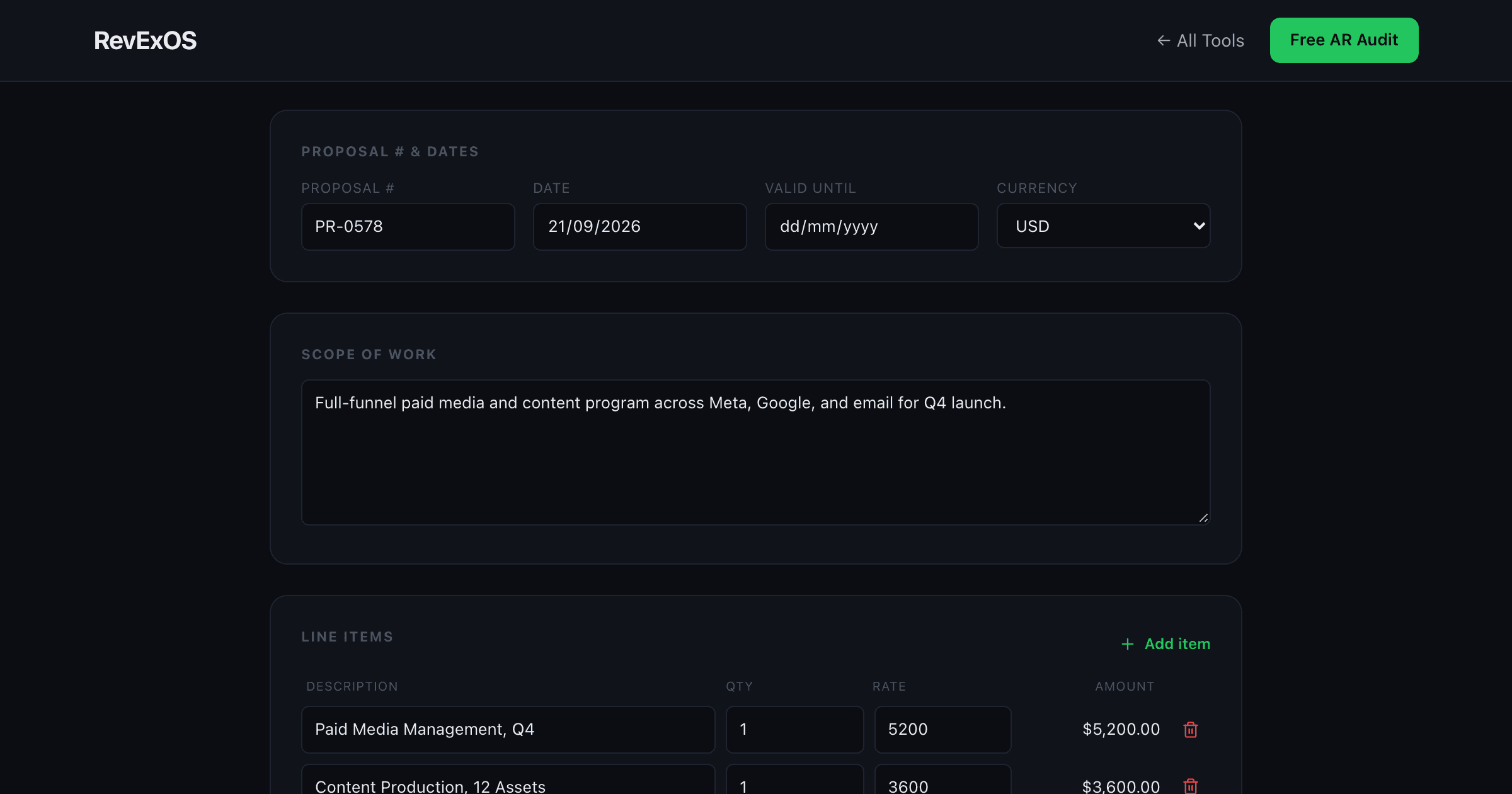
The Proposal Generator has a dedicated Scope of Work field, separate from the line-item pricing table below it. Write the specific version, not the vague one, directly into that field - it's a free-text box, so there's no character limit forcing you to compress a phase-by-phase breakdown into a single vague sentence. Below it, build your line items (description, quantity, rate) to match the deliverables you just named, add a tax rate and currency, and download the PDF.
Once the client accepts, the "Client accepted? Convert to invoice" button carries your business info, client info, line items, tax rate, and currency straight into the Invoice Generator - the specific scope you wrote is what protects that final invoice from a client questioning why a line item exists that wasn't clearly agreed to upfront.
The Pattern, Generalized
Every industry's version of "specific" looks different, but the structure is the same: name what you're delivering, state when each piece arrives, put a number on how much iteration is included, and say out loud what isn't in scope. A proposal that does all four rarely gets renegotiated, because there's nothing left ambiguous enough to renegotiate. A proposal that skips any of them is inviting a conversation you could have avoided by writing one more sentence.
Try it: Proposal Generator. Free, no signup, 2 a day, 5 with an email.
Frequently Asked Questions
- What's the most common reason a proposal gets renegotiated after acceptance?
- A vague scope of work. If deliverables, timeline, revision limits, and exclusions aren't stated explicitly, there's nothing to stop a client from assuming more was included than was actually agreed.
- Should a proposal state what's NOT included?
- Yes. Stating exclusions in the proposal itself prevents the most common category of dispute: a client assuming something was included that wasn't discussed.
- Where do I write the scope of work in the free tool?
- The Proposal Generator has a dedicated Scope of Work field, separate from the line-item pricing table below it.