Quote Templates for Consultants, Agencies, and Accounting Firms
Retainer vs. project quotes for consultants, phased quotes for agencies, and recurring vs. one-time quotes for accounting firms - with a worked line-item example for each and how to build it in the free Quote Generator.
RevExOS
Q2C Consulting
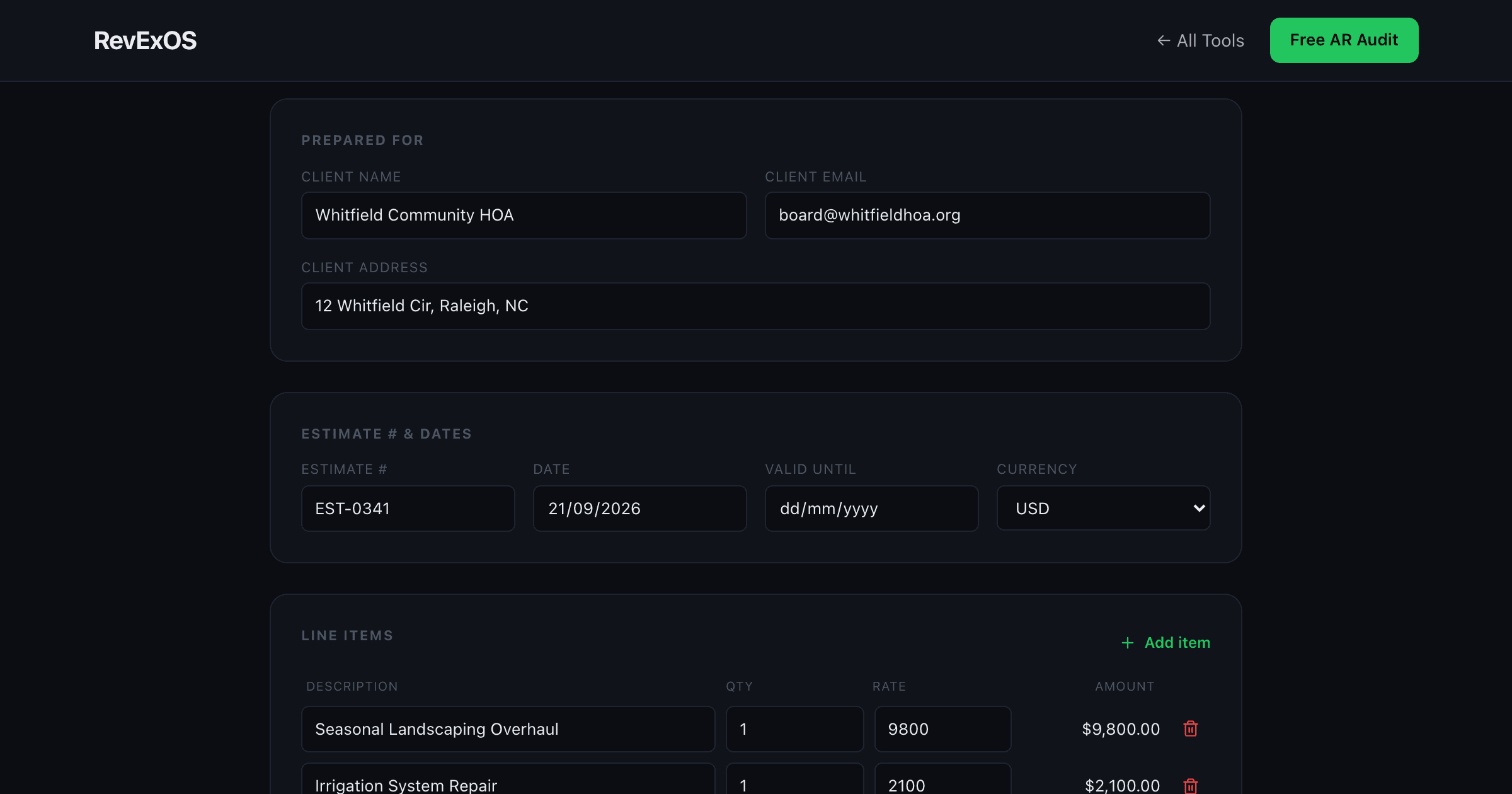
A quote's structure should match how the work is actually going to be billed, not just list a total. A consultant quoting a retainer needs different line items than one quoting a fixed project. An agency quoting a multi-month campaign needs to show phases, not a single lump sum. An accounting firm quoting a monthly bookkeeping engagement needs a completely different structure than one quoting a one-time cleanup project. Below is a concrete structure and worked example for each, plus how to build it in the free Quote & Estimate Generator.
Consultants: Retainer vs. Project-Based Quotes
The single biggest structuring decision for a consultant is whether the engagement is a fixed scope (project-based) or ongoing availability (retainer). These need different line items, because they're pricing different things - a project quote prices deliverables, a retainer quote prices access to your time and expertise over a period.
Project-Based Example
A quote for a one-time strategy engagement should break the deliverable into the actual phases of work, not a single "consulting services" line:
| Description | Qty | Rate | Amount |
| Discovery and stakeholder interviews (5 sessions) | 1 | $2,500 | $2,500 |
| Current-state process audit and findings report | 1 | $3,500 | $3,500 |
| Strategy recommendations deck and roadmap | 1 | $4,000 | $4,000 |
| Implementation kickoff workshop (half-day, on-site) | 1 | $1,500 | $1,500 |
Total before tax: $11,500. Each line item is something the client can independently verify was delivered, which matters if there's ever a dispute about scope.
Retainer Example
A retainer quote should specify the unit being sold (hours or a defined scope per month) and the commitment period, since retainer relationships fail most often when neither party can point to what was actually promised:
| Description | Qty | Rate | Amount |
| Monthly strategic advisory retainer (up to 15 hours) | 3 | $3,000 | $9,000 |
| Additional hours beyond monthly allotment | 0 | $225 | $0 |
Total before tax: $9,000 for a 3-month commitment. Note the second line - listing the overage rate on the quote itself, even at zero quantity, sets the rate for extra hours before the engagement starts rather than becoming a negotiation later.
Building Either in the Tool
Toggle to "Quote," fill in your business and client info, and add each phase or the retainer line as its own line item with quantity and rate rather than a single flat amount - the auto-calculated amount column keeps the math visible to the client. Set the "Valid Until" date to your standard validity window, add your payment terms in the notes field (for a retainer, specify whether billing is upfront or in arrears), and download.
Agencies: Phased and Milestone Quoting
Agencies running multi-month engagements - a website build, a campaign launch, a rebrand - should quote in phases tied to milestones, not a single project total. This does two things: it lets the client see what they're paying for at each stage, and it gives you a built-in structure for milestone-based invoicing later, since each quote line becomes a natural billing trigger.
Worked Example: Website Redesign Project
| Description | Qty | Rate | Amount |
| Phase 1: Discovery, sitemap, and wireframes | 1 | $4,000 | $4,000 |
| Phase 2: Visual design (up to 3 rounds of revisions) | 1 | $6,000 | $6,000 |
| Phase 3: Development and CMS build | 1 | $9,000 | $9,000 |
| Phase 4: QA, launch, and 2 weeks post-launch support | 1 | $2,500 | $2,500 |
Total before tax: $21,500. Note that Phase 2 specifies "up to 3 rounds of revisions" directly in the description - vague revision scope is one of the most common sources of agency scope creep, and stating the limit on the quote itself (not just in a separate contract) means the client saw it before signing.
Building It in the Tool
Each phase is its own line item, in delivery order, so the quote reads top to bottom the same way the project will run. If phases will be invoiced separately as each is completed (the more common approach for engagements over 6-8 weeks), say so explicitly in the notes field: "Each phase is invoiced upon completion and client sign-off." That single sentence on the quote prevents a client from assuming the full amount is due only at the end.
Accounting and Bookkeeping Firms: Recurring vs. One-Time Quotes
Accounting and bookkeeping firms typically quote two structurally different things: a recurring monthly engagement (ongoing bookkeeping, payroll, advisory) and a one-time engagement (a cleanup project, a single-year tax filing, an audit prep). These should look different on paper, because a client evaluating a $600/month recurring quote is asking "is this worth paying every month," while a client evaluating a $4,500 one-time quote is asking "is this worth paying once."
Recurring Monthly Engagement Example
| Description | Qty | Rate | Amount |
| Monthly bookkeeping (up to 200 transactions) | 1 | $450 | $450 |
| Monthly bank and credit card reconciliation | 1 | $100 | $100 |
| Quarterly financial statement review call | 1 | $50 | $50 |
Total before tax: $600/month. Listing "up to 200 transactions" on the recurring line matters - it's the detail that lets you justify a rate increase later if transaction volume grows, without it looking like an arbitrary price hike.
One-Time Cleanup Project Example
| Description | Qty | Rate | Amount |
| 12-month books cleanup and reconciliation (Jan-Dec 2025) | 1 | $3,200 | $3,200 |
| Chart of accounts restructure | 1 | $650 | $650 |
| Prior-year adjusting journal entries | 1 | $450 | $450 |
Total before tax: $4,300, one-time. Specifying the exact date range covered ("Jan-Dec 2025") on the cleanup line closes off the most common accounting-firm scope dispute: a client assuming "cleanup" also covers whatever mess accumulates in the following months.
Building It in the Tool
For the recurring quote, use the notes field to state the billing cadence explicitly: "Billed monthly in advance, cancel with 30 days' notice." For the one-time quote, the "Valid Until" date matters more than usual - a books cleanup quoted in January based on 12 months of transactions is worth re-scoping if the client doesn't accept until June, since more months of activity may have accumulated by then.
The Pattern Across All Three
In every example above, the line items describe deliverables or defined units, not vague categories. "Monthly bookkeeping (up to 200 transactions)" tells a client what they're buying. "Bookkeeping services" doesn't, and it's an invitation to renegotiate what's included once the invoices start arriving. For the wording principles behind this in more depth, see what to include in a B2B quote to make sure your line items close off scope disputes before they start.
Build any of these structures for free in the Quote & Estimate Generator - no signup, and once the client accepts, the same line items carry straight into the Invoice Generator with one click, so the recurring or phased structure you quoted is exactly what gets billed. If you're proposing a larger engagement with narrative context alongside the numbers, the Proposal Generator pairs a written proposal with the same pricing structure.
Frequently Asked Questions
- Should a consulting retainer include ad hoc requests?
- Only what's explicitly stated. State an hours cap on the retainer line and bill anything beyond it as its own line item to prevent scope creep.
- How should agencies structure a fixed-price project quote?
- Break it into phases (for example, Discovery, Design, Production) with its own line and price, so each phase can double as a milestone-payment checkpoint.
- How do bookkeeping firms avoid losing margin as clients grow?
- Cap the flat monthly fee to a stated transaction volume and add an explicit per-unit overage rate for anything beyond it.