What to Include in a B2B Quote to Stop Scope Renegotiation
Specific line items, a stated validity window, payment terms up front, and a change-request clause: the four things that stop a client from successfully renegotiating scope after signing.
RevExOS
Q2C Consulting
Most quotes fail not because the price was wrong, but because the wording left room to argue about what the price actually covered. A client who wants more than they paid for doesn't usually say so directly - they point at a vague line item and argue it was always supposed to include what they're now asking for. A well-worded quote closes that argument before it starts. Here's what actually needs to be on the document.
Specificity in Line Item Descriptions
"Consulting services - $5,000" is not a line item, it's a placeholder that invites a client to fill in whatever scope they want after the fact. The fix is describing exactly what's included and, just as importantly, what's excluded.
Vague: Website development - $8,000
Specific: Custom WordPress website build, up to 8 pages, includes one custom homepage design and 2 rounds of revisions. Excludes copywriting, stock photography licensing, and ongoing hosting or maintenance after launch. - $8,000
The second version does three things the first doesn't: it states a page count (so "just one more page" has a defined boundary), it caps revisions (so revision requests have a stopping point), and it explicitly excludes adjacent work a client might otherwise assume is included (copywriting and hosting are extremely common assumptions on web projects). Every one of those details is a future argument that never happens because the quote already answered it.
The same logic applies to any service. A bookkeeping quote should state a transaction volume cap. An agency quote should state a number of revision rounds. A consulting quote should state a number of sessions or hours. Any noun in your line item that could reasonably mean different things to you and the client - "support," "design," "consulting," "management" - needs a number or a boundary attached to it.
A Stated Validity Window
Every quote should have an explicit "Valid Until" date, and 30 days is the standard window for most B2B services. There are two concrete reasons a validity date matters, not just convention:
Your costs and availability change. A rate you quoted in January based on your current workload might not make sense in June if you've since raised prices, gotten busier, or the project's original assumptions have shifted (more source material, more integrations, a different timeline). Without a validity date, you're implicitly honoring a quote indefinitely, which means a client can accept a rate you'd no longer offer if you were quoting today.
It removes ambiguity about what happens after expiration. A quote with no validity date creates a genuine question when a client comes back three months later wanting to accept: is the price still good? Nobody wants to have that conversation, and having a stated date means you don't have to - the quote itself already answered whether it's still active, and if it's expired, re-quoting is a normal, expected step rather than an awkward renegotiation.
Set the date deliberately based on how quickly your costs or availability actually move: 30 days works for most project and retainer quotes, but a quote dependent on a live vendor cost (materials, ad spend commitments, a subcontractor rate that fluctuates) might need a shorter window, like 7-14 days.
Payment Terms Stated Up Front, Not Left for the Invoice
Payment terms belong on the quote, not just the eventual invoice. If a client is agreeing to $12,000 for a project, they should also be agreeing, in the same document, to how and when that $12,000 gets paid - 50% upfront and 50% on delivery, net 30 from invoice date, monthly in arrears, whatever your actual terms are. Waiting until the invoice to introduce payment terms means the client is discovering a condition of the deal after they've already told their own stakeholders the project is approved at a given price, which is exactly when pushback on terms is hardest to resolve and most likely to delay your first payment.
Put terms in the notes or terms field on the quote itself: "50% deposit due upon acceptance, remaining 50% due upon delivery. Net 15 on the final invoice." This also gives you a documented basis to pause work if a deposit doesn't arrive - "the quote you signed states a 50% deposit before work begins" is a much stronger position than an undocumented expectation.
What Happens With Change Requests After Acceptance
Scope changes after a quote is accepted are normal - the question a well-worded quote answers in advance is what happens when one comes up, not whether one will. A single sentence in the terms section handles this: "Any work outside the scope described above will be quoted separately before it begins." That sentence does the actual work of preventing scope creep. Without it, a client's "can you also just..." request during the project has no defined process, and the path of least resistance for most service providers is to just do it, quietly expanding scope for free until the accumulated extra work is large enough to notice - by which point it's awkward to bill for retroactively.
With that sentence on the quote, a new request has an obvious next step: it gets a new quote line or a change order, agreed to before the work starts, not absorbed silently into the original price. This isn't about being rigid with clients - it's about making sure additional work is a visible, billable decision instead of an invisible, unpaid one.
Putting It Together: A Quote That's Hard to Renegotiate
A B2B quote that closes off post-signing renegotiation has, at minimum:
- Line items with specific inclusions and explicit exclusions, not category names
- Quantities or caps attached to anything that could otherwise be interpreted as unlimited (revision rounds, transaction volume, hours, page counts)
- A stated validity date, typically 30 days
- Payment terms in the document itself, not deferred to the invoice
- A one-line change-request clause stating that out-of-scope work is quoted and agreed separately
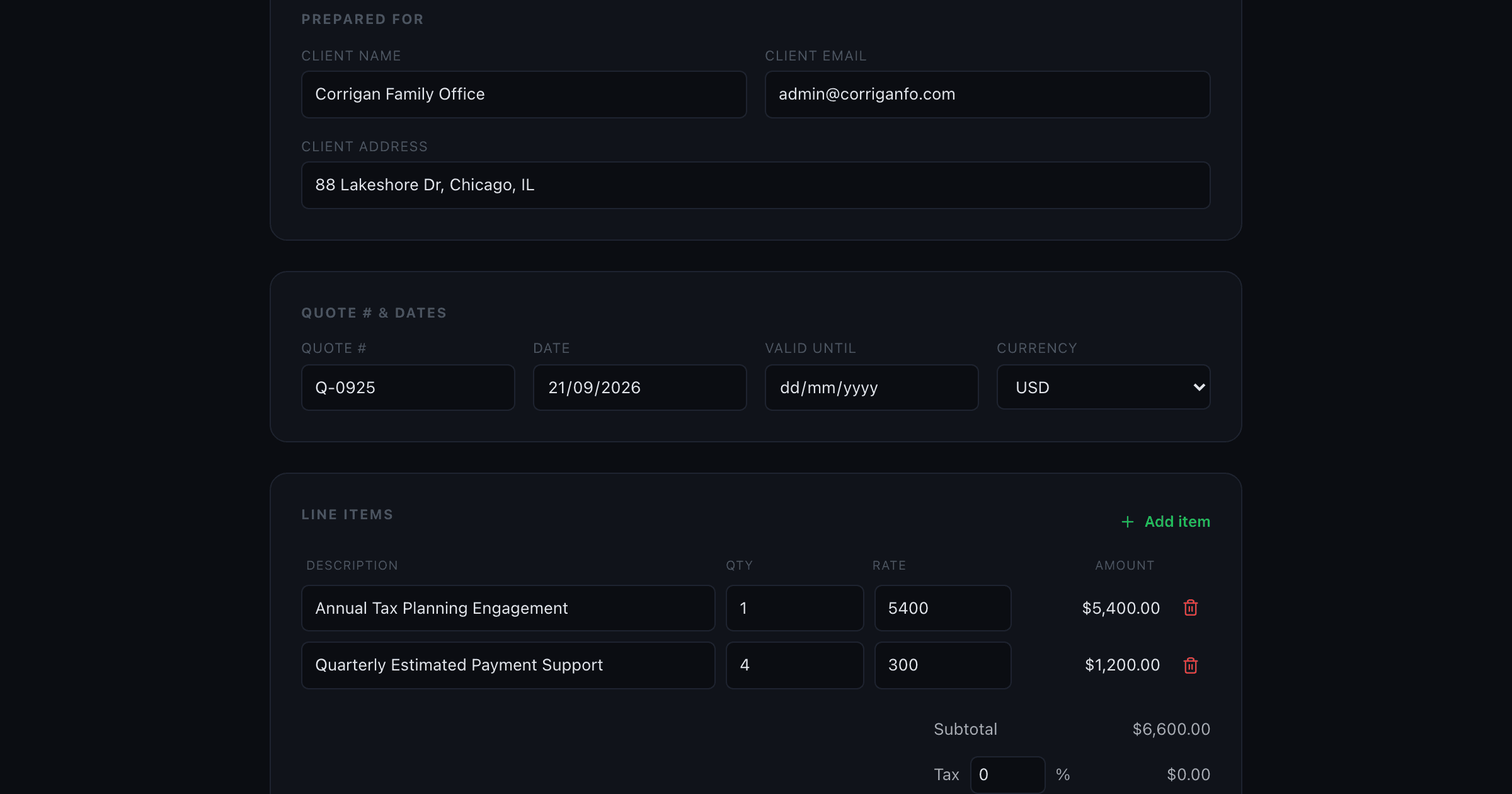
None of this requires a lawyer or a lengthy contract - it requires being specific in a document you're probably already sending. The Quote & Estimate Generator gives you a "Valid Until" date field built into the form, a notes/terms field for payment terms and the change-request clause, and line items with quantity and rate so amounts are calculated rather than eyeballed. It's free, requires no signup, and once the client accepts, the same specific line items carry straight into the Invoice Generator with one click - so the scope you were careful to define in the quote is exactly what gets billed, with nothing softened or generalized in the retyping.
If you're quoting a larger engagement that needs narrative explanation alongside the pricing, the Proposal Generator pairs written context with the same discipline around scope.
Frequently Asked Questions
- Why do most quotes default to a 30-day validity period?
- It's long enough to cover a normal internal approval cycle and short enough that your costs and availability haven't materially changed by the time it's accepted.
- What's the difference between a change order and scope already included?
- If a quote doesn't explicitly list something as included, it should be treated as excluded and quoted separately as a change order rather than absorbed silently.
- What happens if a quote doesn't state its terms clearly?
- Disputes surface later, usually as pushback on an invoice line, a scope argument mid-project, or an outdated rate the client assumes still applies.