Best B2B Accounts Receivable Automation Software in 2026, Compared
HighRadius, Billtrust, Quadient (YayPay), Upflow, Chaser, Kolleno, Gaviti, and Bill.com, compared on pricing, ERP integration, and who they actually fit - plus when a managed service beats buying software at all.
RevExOS
Q2C Consulting
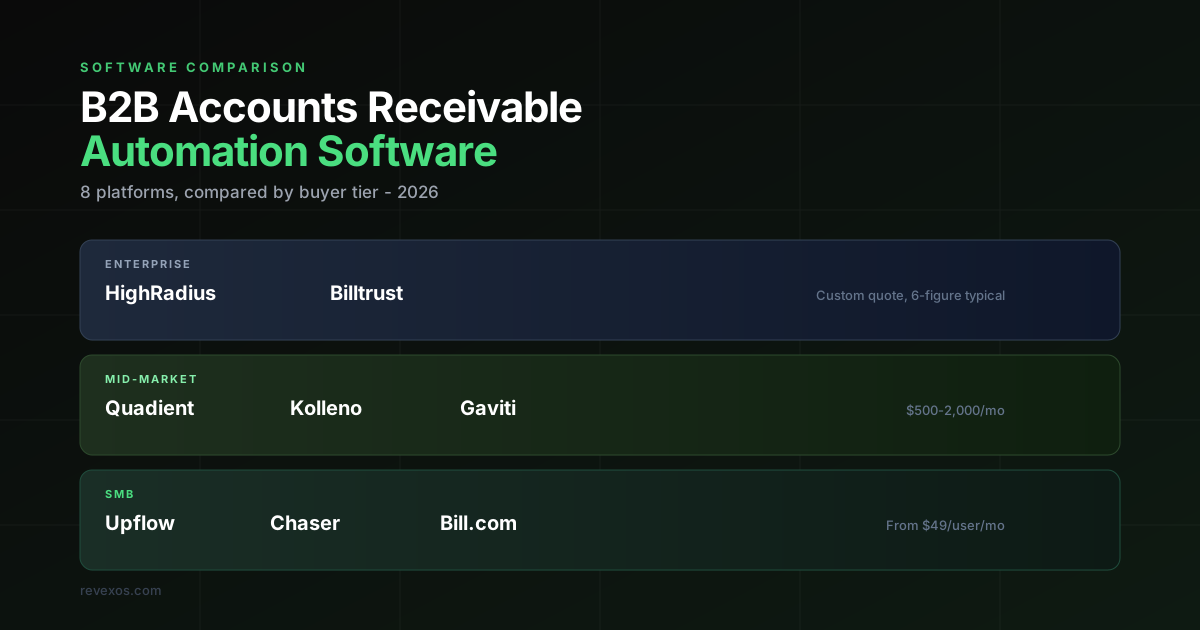
"B2B accounts receivable software" is a buyer's-intent search, not a how-to search. If you landed here, you have almost certainly already decided you need something and are now trying to work out which something, at what price, and whether it will actually connect to the QuickBooks, Xero, or NetSuite instance you already run your books on. This is that comparison: eight real platforms, what they cost as of 2026, and who each one actually fits, organized by the buyer tier that matters most, company size and AR complexity, not by which vendor paid for the placement.
For the difference between buying software you configure yourself versus a service that runs AR for you, see AR Automation Software vs. AR Automation Service. This post stays inside the software category and compares the vendors directly.
The Comparison
| Tool | Tier | Pricing | ERP/Accounting Integration | Best Fit |
| HighRadius | Enterprise | Custom quote, six figures typical | SAP, Oracle, NetSuite, major ERPs | Large global enterprises, multi-entity, high AR volume |
| Billtrust | Enterprise | Custom quote | Broad payment network, major ERPs | Enterprises needing wide payment-network reach |
| Quadient (YayPay) | Mid-market | Custom quote | Multiple ERP integrations | Mid-market finance teams wanting predictive cash application |
| Kolleno | Mid-market | From £650/user/month | Receivables + payments + reconciliation in one platform | Teams wanting AR and payment reconciliation unified |
| Gaviti | Mid-market | $500-2,000/month | Multiple accounting systems | Mid-market collections workflow automation |
| Upflow | SMB-to-mid | From ~$440/month (undisclosed public pricing) | Xero, QuickBooks Online, NetSuite, Sage Intacct, Stripe Billing, Chargebee | B2B teams whose main problem is collecting overdue invoices |
| Chaser | SMB | Compact £199/mo (under £4M revenue), Core £599/mo (under £10M), Complete £899/mo (under £100M) | QuickBooks, Xero | SMBs that want tiered pricing to match their revenue band |
| Bill.com (BILL) | SMB | Essentials $49, Team $65, Corporate $89/user/month | QuickBooks Online, QuickBooks Pro, Xero, native | SMBs already on QuickBooks/Xero wanting AR and AP together |
Pricing above is what each vendor or independent comparison sites reported as of this writing. Several of these vendors do not publish pricing at all and quote per-deal, so treat every number here as a starting point for a sales conversation, not a rate card you can commit to sight unseen.
Enterprise Tier: HighRadius and Billtrust
HighRadius is built for large global enterprises with multi-entity structures, high invoice volume, and the internal budget and implementation capacity that comes with SAP- or Oracle-scale finance operations. It is genuinely capable software: AI-assisted cash application, credit management, and collections all in one suite. It is also genuinely not built for a 20-person accounting firm or a bootstrapped agency, the implementation timeline and cost put it out of reach below a certain AR volume, and most companies below enterprise scale would be paying for capacity they will not use.
Billtrust competes at the same tier with a specific strength: payment-network reach. If your customers pay through a wide variety of channels and you need one platform that speaks to all of them, Billtrust's near quarter-century in this space shows in how broadly it connects. Same caveat as HighRadius: this is enterprise software with enterprise pricing and implementation timelines to match.
Mid-Market Tier: Quadient (YayPay), Kolleno, and Gaviti
Quadient (YayPay) is the mid-market answer to HighRadius's enterprise capability: predictive cash application, automated dispute handling, and multiple ERP integrations, without the enterprise-only pricing floor. This is a realistic option for a finance team with real AR headcount and complexity, not a solo bookkeeper.
Kolleno unifies receivables, payments, and reconciliation into one AI-assisted platform, which is a genuine differentiator if your AR pain is specifically that those three functions live in three disconnected tools today. The tradeoff is pricing: at £650 per user per month, cost scales directly with how many people on your team need seats, which punishes exactly the lean team structure common at professional services firms and growing agencies.
Gaviti sits in the same $500-2,000/month range as Kolleno and focuses on collections workflow automation specifically: dunning sequences, payment reminders, and AR aging visibility, without trying to be a full payments platform on top.
The pattern across this tier: real capability, but per-user or per-month pricing that gets expensive fast for a team that is lean by design, which describes most of the professional services and agency businesses this site's audience actually runs.
SMB Tier: Upflow, Chaser, and Bill.com
Upflow is the strongest option in this tier if your actual problem is collecting on overdue invoices specifically, not managing the full AR back office. It syncs directly with Xero, QuickBooks Online, NetSuite, Sage Intacct, Stripe Billing, and Chargebee, automated reminders, a branded customer payment portal, promise-to-pay tracking, and real-time AR analytics. Public pricing isn't published, but reported entry pricing starts around $440/month.
Chaser is the one vendor in this comparison that prices explicitly by your revenue band rather than a flat per-seat fee: Compact at £199/month for businesses under £4M revenue, Core at £599/month under £10M, Complete at £899/month under £100M. That structure is worth calling out because it is the most transparent pricing model of any vendor here, you know roughly what tier you fall into before a sales call, which the custom-quote vendors above do not offer.
Bill.com (BILL) is the option most likely to already be on your radar, since it combines AR and AP on one platform with native QuickBooks Online, QuickBooks Pro, and Xero integration. At $49-89 per user per month depending on tier, it is the cheapest seat price in this comparison, though it is a general bill-pay platform with AR automation as one feature, not an AR-first tool the way Upflow or Chaser are.
What Actually Matters More Than the Feature List
Every vendor above will show you a demo with AI-powered dunning, predictive payment dates, and a clean dashboard. The feature list looks similar across all eight because the core AR automation feature set has converged: automated reminders, a payment portal, cash application matching, and aging reports are table stakes now, not differentiators.
The thing that actually determines whether an implementation succeeds or turns into six months of half-finished configuration is ERP integration depth, specifically whether the sync with your QuickBooks, Xero, or NetSuite instance is real two-way sync or a one-way, batch-delayed connection that requires manual reconciliation anyway. Ask every vendor on this list, directly, whether invoice status updates flow back to your accounting system in real time or on a delay, and whether payment application in the tool automatically closes the invoice in your books or just marks it paid inside their platform. The answer to that question predicts your actual day-to-day experience far better than the demo does.
When Buying Software Isn't the Right Move at All
Every vendor in this comparison sells you a tool: you configure it, your team runs it, and when something breaks, a disputed invoice, a payment that doesn't match, a customer who's gone quiet, your team is the one who resolves it inside that tool. For a team with AR headcount and the bandwidth to own that operating work, that's a reasonable trade.
For a lean team, an accounting firm managing collections across many clients, or an agency where nobody's actual job title is "AR specialist," the operating burden of running any of these eight tools well is often the real cost, not the license fee. That's the gap a managed AR automation service is built to close: no new seat to configure, built directly on the QuickBooks or Xero account you already use, with disputes and exceptions triaged before they reach your inbox instead of sitting in a queue inside a new platform. See the full breakdown in AR Automation Software vs. AR Automation Service for the decision framework on which model actually fits your team.
Which One Should You Actually Evaluate First?
If you're enterprise-scale with the implementation budget to match, HighRadius or Billtrust are the realistic short list. If you're mid-market with real AR headcount and complexity, Quadient (YayPay), Kolleno, or Gaviti fit, pick based on whether payments/reconciliation unification (Kolleno) or predictive cash application (Quadient) matters more to your specific gap. If you're an SMB or lean team whose main pain is collections specifically, start with Upflow or Chaser and use Chaser's revenue-band pricing to sanity-check what you should expect to pay before any sales call. If none of that sounds like a fit because your actual problem is that nobody has the bandwidth to run any AR tool well, that's the signal to look at a service instead of a seventh software demo.
Frequently Asked Questions
- What's the cheapest B2B accounts receivable automation software?
- Bill.com (BILL) has the lowest published seat price in this comparison at $49-89 per user per month, with native QuickBooks Online and Xero integration. It's a general bill-pay platform with AR as one feature, not an AR-first tool.
- Which AR automation software actually integrates with QuickBooks or Xero?
- Upflow, Chaser, and Bill.com all have native QuickBooks/Xero sync. Upflow additionally connects to NetSuite, Sage Intacct, Stripe Billing, and Chargebee. Always confirm whether the sync is real-time two-way or a delayed one-way batch before buying.
- Is there an alternative to buying AR automation software?
- Yes, a managed AR automation service runs collections, cash application, and exception handling for you on the accounting system you already use, instead of you configuring and operating a new tool yourself. See AR Automation Software vs. AR Automation Service for the decision framework.