Short Payments, Deductions, and Overpayments: What to Do
A customer paid the wrong amount. The gap is a cost to expense, money to recover, or a credit you owe. How to tell which, and how to handle each one.
RevExOS
Q2C Consulting
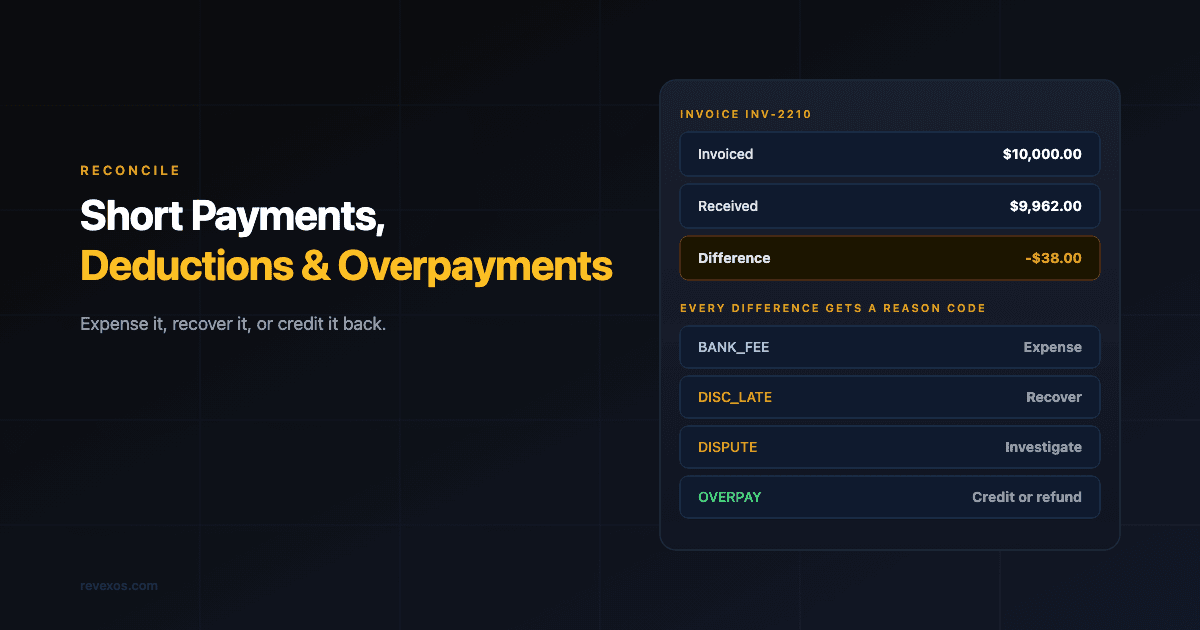
An invoice for $10,000. A payment of $9,962. The difference is $38, and the easiest thing to do with $38 is to write it off and move on.
Do that a few hundred times a year and the write-offs add up to real money. Worse, some of those $38 differences were never the customer's to deduct, and some of them are the first sign of a dispute that will cost far more than $38 when it surfaces properly.
When a payment does not match the invoice, the difference falls into one of three groups:
- A cost you should record, such as bank fees or withholding tax.
- Money you can recover, such as an unauthorized deduction, a discount taken late, or a mistake.
- Money you owe back, such as a duplicate payment or an overpayment.
This guide covers how to tell them apart and what to do with each. It is the second half of the reconcile stage, after cash application has matched the payment to its invoice.
Step one: classify the difference
Every mismatch should get a reason code at the moment it is found, not at month-end. A reason code turns a pile of odd amounts into a report you can act on. A practical set:
| Code | Meaning | Usually |
|---|---|---|
| BANK_FEE | Intermediary or receiving bank charges | Expense |
| WHT | Withholding tax deducted by the customer | Tax asset, needs a certificate |
| FX | Currency conversion difference | FX gain or loss |
| DISC_VALID | Early payment discount taken within terms | Discount allowed |
| DISC_LATE | Discount taken after the discount window | Recover |
| DISPUTE | Customer disputes a line, quantity, or price | Investigate |
| PRICING | Customer paid an old or different price | Investigate |
| UNKNOWN | No explanation given | Investigate |
| OVERPAY | Paid more than the invoice | Credit or refund |
| DUPLICATE | Paid the same invoice twice | Credit or refund |
The invoice vs payment reconciliation tool will tell you instantly whether an invoice is short paid, fully paid, or overpaid, and by how much. The classification is the part that needs the remittance, the contract, and judgment.
Short payments you should expense
Bank fees on international payments
International wires often arrive light because banks in the chain take a fee. SWIFT payments carry a charge instruction:
- OUR: the sender pays all fees, and you should receive the full amount.
- SHA: fees are shared. The sender pays their bank, and intermediary and receiving bank fees come out of what you receive.
- BEN: the beneficiary (you) pays all fees.
Most business wires default to SHA, which is why a $10,000 invoice arrives as $9,962. You cannot recover that from the customer unless your terms say so. If international fees are material to you, put it in the contract and on the invoice: "All bank charges are for the payer's account (OUR)." Then the difference moves from "expense" to "recoverable".
Set a small tolerance (for example, under $50 on foreign-currency wires) that auto-applies the payment and books the difference to bank charges, so these never reach a person.
Withholding tax
In many countries, a customer paying a foreign (or sometimes domestic) supplier must withhold a percentage of the payment and pay it to the tax authority. India's TDS and cross-border withholding on services are common examples. The customer pays you the net amount and should give you a withholding tax certificate.
That certificate is the whole game. With it, the withheld amount is usually a tax credit you can claim, not a loss. Without it, it is just a short payment. So:
- Record the withheld amount against the invoice as WHT, not as a write-off.
- Keep a list of outstanding certificates by customer and chase them like any other receivable.
- Where a tax treaty lowers the rate, send the customer the paperwork (such as a tax residency certificate) before the first invoice, not after the first short payment.
Get specific advice for your jurisdiction. The point for reconciliation is that WHT needs its own code and its own follow-up.
Currency differences
If you invoice in USD and the customer pays in EUR, or the payment is converted along the way, the amount received will differ from the invoice. That difference is a foreign exchange gain or loss, and belongs there, not in bad debt. The real fix is on the quote and invoice: state the invoice currency and who carries conversion costs.
Short payments you should recover
Early payment discounts taken late
Terms like "2/10 net 30" give the customer 2% off if they pay within 10 days. Some customers take the 2% whatever day they pay. On a $50,000 invoice, that is $1,000 per invoice.
Check the payment date against the discount window every time. If the discount was taken late, bill it back politely, with the dates. Many customers will pay it without argument, because their AP system took the discount automatically and nobody noticed. The payment terms benchmarker is useful here for deciding whether an early payment discount is worth offering at all.
Disputed lines
A customer who disagrees with one line on a ten-line invoice often pays the other nine and deducts the tenth. That is actually a good outcome compared with holding the whole invoice. But the deduction is now an open dispute, and it needs:
- An owner (usually the account manager, not AR).
- The evidence: the signed quote or order, the PO, delivery confirmation, timesheets.
- A deadline, after which it escalates.
Most disputed deductions trace back to something earlier in the cycle: a scope change that was never re-papered, a PO that did not match the quote, or a price the customer never agreed to. Track the root cause for each one. If the same cause keeps appearing, fix it where it starts, usually at the order and contract stage.
Pricing and "unknown" differences
A customer pays last year's price, or pays a round number with no explanation. These are the deductions most often written off, and the ones most often recoverable. Send a short, specific note with the invoice, the amount paid, the difference, and a request to pay the balance or explain it. The AR collections email generator produces a good starting draft.
When to write off small balances
Chasing $3.17 costs more than $3.17. Every firm needs a written small-balance policy, so the decision is made once and not every time. A reasonable one:
- Auto write-off threshold: for example, differences under $10 or under 0.1% of the invoice, whichever is lower, coded as SMALL_BALANCE.
- Only for expected causes: bank fees and rounding, never for a disputed line or an unexplained round-number deduction.
- Reviewed monthly: total the small-balance write-offs by customer. If one customer keeps appearing, they are not paying bank fees, they are paying a different amount on purpose.
Everything above the threshold gets a reason code and an owner.
Overpayments and duplicates
Overpayments feel like good news. They are a liability. The money is not yours until it is applied to something the customer owes, or returned.
The common causes:
- Duplicate payments: the customer paid the invoice twice, often once from a reminder email and once from their AP run.
- Paid the wrong invoice: they paid an invoice that was already credited or cancelled.
- Rounding up or paying a quote amount: they paid the quote total, not the final invoice.
What to do:
- Apply the payment to the invoice and hold the difference as a credit on the customer's account. Do not leave it as unapplied cash, where nobody sees it.
- Tell the customer within a few days, and give them a choice: apply the credit to the next invoice, or receive a refund. Put it in writing.
- Refund promptly if asked. Holding a customer's money because it is convenient is a poor way to treat a customer.
- Do not leave old credit balances sitting forever. In the US, unclaimed customer credit balances can fall under state unclaimed property rules after a period of years. Review credit balances quarterly.
Duplicate payments are also a signal: if customers often pay twice, your reminders may be going out after a payment was already sent. Check that your dunning sequence pauses when a payment is pending, and that cash is applied fast enough that reminders see it. The guide to dunning cadences covers the timing.
Build it into the process
Short payments, deductions, and overpayments are not exceptions to reconciliation. They are a normal part of it, and they need a process like any other:
- Tolerance rules apply and code expected small differences automatically.
- Reason codes go on every difference above tolerance, at the moment it is found.
- Owners and deadlines for every recoverable deduction.
- A monthly report: deductions by reason, by customer, and recovered versus written off.
- Upstream fixes for the top reasons: payment instructions on the invoice, fee terms in the contract, cleaner POs.
The monthly report is where the value is. It usually shows that a handful of customers and two or three root causes produce most of the deductions, and most of those causes started at the quote or the contract, long before the payment arrived.
For the full picture of how each stage hands off to the next, see the lead-to-cash overview.
Frequently Asked Questions
- What is a short payment?
- A short payment is a customer payment that is less than the invoice amount. The difference can come from bank fees, withholding tax, currency conversion, an early payment discount, a disputed line, or an error, and each cause is handled differently.
- Should I write off small short payments?
- Only under a written small-balance policy with a threshold, for example differences under $10 or 0.1% of the invoice, and only for expected causes like bank fees or rounding. Never auto-write off unexplained round-number deductions or disputed lines, and review write-offs by customer every month.
- Why do international payments arrive short?
- Most international wires use the SHA charge option, where intermediary and receiving bank fees are deducted from the amount you receive. If your contract and invoice say all bank charges are for the payer's account (OUR), you can recover those fees from the customer.
- What should I do with a customer overpayment?
- Apply the payment to the invoice, hold the extra as a credit on the customer's account, and tell the customer within a few days. Offer to apply the credit to the next invoice or refund it. Do not leave it as unapplied cash or let old credit balances sit indefinitely.
- What is a deduction in accounts receivable?
- A deduction is an amount a customer subtracts from a payment on purpose, such as a disputed charge, a pricing disagreement, or a discount. Deductions need a reason code, an owner, and a deadline, because many of them are recoverable if followed up promptly.